Make the gaps visible before trying to smooth them
A busy delivery month can look like commercial success while quietly creating the next empty month. The team stops business development, every promising conversation is counted as future revenue, and payment is expected long after the work consumes people and cash. When the current project ends, the sales cycle starts again from zero.
The owner decision is not “projects or recurring revenue”. It is whether the business can see and control the next handoff from demand to delivery to cash. A recurring offer may help when customers genuinely need continuing work. It is not a cure for weak qualification, uncontrolled customisation, poor sequencing or late invoicing.
This is a different problem from making custom work more repeatable, growing when the team is at capacity or deciding whether to introduce a subscription model. Here, the goal is a more reliable operating rhythm for work that remains project-based.
The cycle is usually four mismatched clocks
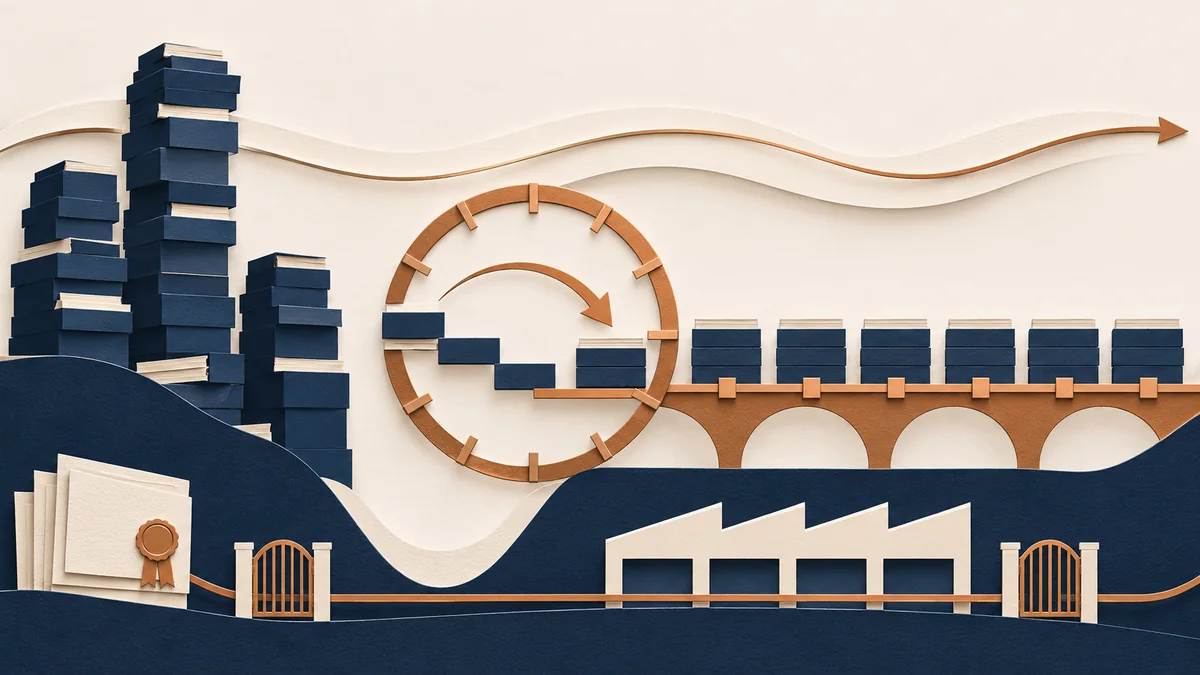
Project businesses do not have one revenue clock. They have at least four. Sales has a lead-to-decision cycle. Delivery has a start-to-completion cycle. Contracts have an invoice schedule. Customers have an actual payment cycle. A headline pipeline total hides the differences between them.
Australian government guidance recommends using cash-flow records to identify payment cycles and seasonal patterns, forecast shortages and compare estimated with actual income and costs. It also notes that clear payment terms, prompt collection and regular updates help a business prepare for busy and quiet periods. Those controls matter, but cash visibility alone cannot create the next suitable project. The commercial system must protect demand activity while delivery is busy.
That is the content gap in much existing advice. Current search results frequently reduce feast-or-famine growth to cash forecasting software, freelancer retainers or “sell more”. An owner needs a combined view of backlog, probability, capacity and collection—not another isolated tactic.
The Project Revenue Rhythm Gate
Use these six questions before hiring, increasing marketing spend, accepting a weak-fit project or promising a start date. Each question should have a named owner and a source of evidence.
What must stay protected?
Know the operating cash floor, fixed commitments and loss boundary before using a busy month to justify expansion.
What is actually signed?
Place contracted work into delivery months. Do not treat total contract value as cash available today.
What could start next?
Separate qualified buying conversations by likely decision and start window instead of one optimistic pipeline total.
What can be delivered well?
Map usable delivery slots, critical skills and sales ownership before accepting work that blocks higher-value commitments.
When does value become cash?
Align deposits and milestone invoices with the costs and risks incurred as the project progresses.
What valuable step follows?
Define a real next problem, maintenance need or expansion path. Do not invent a retainer with no continuing customer value.
Build a four-layer Project Revenue Rhythm Map
The map is a forward view by week or month. Keep four rows separate: signed backlog, probable starts, deliverable capacity and collectible cash. A project can appear in more than one row, but the amounts and dates will differ.
| Layer | What belongs here | Owner question | Common mistake |
|---|---|---|---|
| Signed backlog | Contracted scope assigned to expected delivery periods | Where is the next unfilled month? | Counting the entire contract in its signature month |
| Probable starts | Qualified opportunities with a decision event and plausible start window | What evidence moves this towards signed? | Applying one probability to every stage |
| Delivery capacity | Usable team or partner slots after current commitments and quality limits | Which work fits without creating delivery debt? | Treating every available hour as sellable |
| Collectible cash | Deposits and milestone invoices expected under agreed terms | Does cash arrive before the business carries too much cost? | Confusing invoiced revenue with money received |
A contract should state payment timing clearly. Business.gov.au notes that full payment at the end may leave a provider financing materials and work for a long period, while deposits or progress payments can cover start-up costs and tie payment to dates or milestones. The contract should specify the due date, milestone, amount and acceptable work. The UK Small Business Commissioner likewise recommends agreeing payment terms before work begins, invoicing promptly and monitoring invoices.
Choose the next move from the constraint
| Observed pattern | Likely constraint | Owner move | Avoid |
|---|---|---|---|
| Busy now; next-start pipeline is thin | Sales activity stopped during delivery | Protect a weekly demand cadence and qualify future starts | Waiting for the current project to finish |
| Strong pipeline; no safe delivery slots | Sequencing or capacity | Stage starts, narrow scope, price scarcity or use verified partners | Promising every project the same start date |
| Backlog is healthy; cash is tight | Payment timing or collection | Repair deposits, milestones, invoicing and follow-up | Buying more leads to cover a collection problem |
| Idle capacity; weak qualified demand | Market, offer or acquisition | Run one focused demand test with a loss boundary | Discounting every service at once |
| Natural post-project need repeats | Continuity opportunity | Pilot maintenance, optimisation or advisory with a clear outcome | Renaming general availability as a retainer |
The Demand-to-Collected-Project Value Loop
Run one loop every week. First, reconcile the four-layer map against what actually changed. Second, locate the earliest future gap. Third, identify the constraint: demand, qualification, sequencing, capacity, contract or collection. Fourth, choose one commercial move. Fifth, assign an owner and decision date. Sixth, compare forecast with actual cash and delivery evidence, then update the next window.
Hypothetical example—not a client result or benchmark
A specialist project firm reports a £300,000 pipeline. The rhythm map shows only £80,000 signed, £45,000 expected to be collected in the next 60 days and £120,000 of safe delivery capacity. The decision is not to hire against the headline pipeline. It is to protect two future start slots, move qualified opportunities to a dated decision, and align the next contracts with deposits and milestones.
The numbers are deliberately illustrative. Replace them with the business's signed contracts, CRM stages, capacity assumptions, payment terms and bank evidence. Record uncertainty instead of converting it into false precision.
Marketing supports the rhythm when it is tied to a specific demand gap. Use Google Ads for existing demand where appropriate, focused landing pages to clarify fit, and conversion tracking to connect enquiries with qualified project opportunities. Also review the guide to recovering an empty pipeline, stabilising lead generation before scaling, the case evidence, evidence standards and Thomas's direct operating model.
Sources and evidence notes
Sources and current search results were checked on 5 November 2026. The Project Revenue Rhythm Gate, four-layer map, decision matrix and Demand-to-Collected-Project Value Loop are original ThomPerformance analysis. The worked numbers are hypothetical and are not presented as client performance, a benchmark or a forecast.
Frequently asked questions
Why do project-based businesses experience feast-or-famine revenue?
Project work creates uneven start dates, delivery periods and payment events. The pattern becomes more severe when sales activity stops during delivery, pipeline stages are treated as equally certain, capacity is not reserved deliberately, or invoices are disconnected from the costs incurred to complete the work.
Does a project-based business need retainers to make revenue predictable?
No. A retainer is useful only when the customer receives continuing value and the provider can deliver it repeatedly. Predictability can also improve through clearer backlog visibility, continuous business development, staged starts, deposits, milestone payments, maintenance work and well-timed follow-on projects.
How much backlog should a project business keep?
There is no universal number of months. The right level depends on sales-cycle length, project duration, delivery capacity, payment terms, margin and cash reserves. Track signed work by expected delivery month and compare it with capacity and cash obligations rather than relying on headline contract value.
Should a fully booked business stop marketing?
Usually not completely. Reduce or redirect acquisition if delivery quality is at risk, but keep a controlled demand cadence. Otherwise the next sales conversation starts only after the current workload ends, creating a preventable gap equal to the business's sales cycle.
What should an owner review each week?
Review signed backlog by delivery month, qualified opportunities by likely start window, available delivery slots, invoices due, cash expected and the next commercial action. The aim is to find the first future gap while there is still time to change demand, sequencing, pricing or payment terms.
Replace the revenue rollercoaster with a decision rhythm
Project revenue will rarely become perfectly even, and it does not need to. The practical goal is to find the next gap early, preserve sales activity through busy periods, sell only the capacity the business can deliver well, and collect cash in step with the value and risk of the work.
Which future month would become visible if signed backlog, likely starts, capacity and cash were finally shown on one page?