
More leads are not useful when the acquisition system is still moving underneath them
Volatile lead delivery creates a tempting response: raise budget during a good week, cut it during a bad one and replace creative whenever the dashboard becomes uncomfortable. That behaviour can make the evidence harder to read. The business changes several inputs before it knows whether the offer, audience, message, conversion event or follow-up process caused the movement.
My verdict is: stabilise the decision system before scaling the media system. Keep enough of the offer, market, conversion definition and sales process consistent to interpret performance. Make one material change at a time where practical. Then return qualified and converted outcomes—not just form submissions—to the next investment decision.
This intent is distinct from the education lead-to-enrolment case, which explains how campaign activity connected to CRM stages and enrolments. It also differs from the guide to increasing advertising budget, which covers the broader capital-allocation decision. This page focuses on the operating problem that comes first: lead delivery is too volatile to scale confidently.
What the documented lead-generation case shows
The approved portfolio record covers an anonymised national education brand using Meta advertising from January to September 2025. Lead delivery was volatile. My recorded contribution was to consolidate the account around clearer conversion signals, refresh creative by customer angle and move budget towards combinations producing both volume and usable lead quality.
The source trend begins at roughly 600 monthly leads and finishes above 1,100. Cost per lead reached a peak of approximately VND 1.04 million in February and finished September at approximately VND 0.84 million. The record therefore shows higher monthly lead volume and a closing cost below the earlier peak during the stated period.
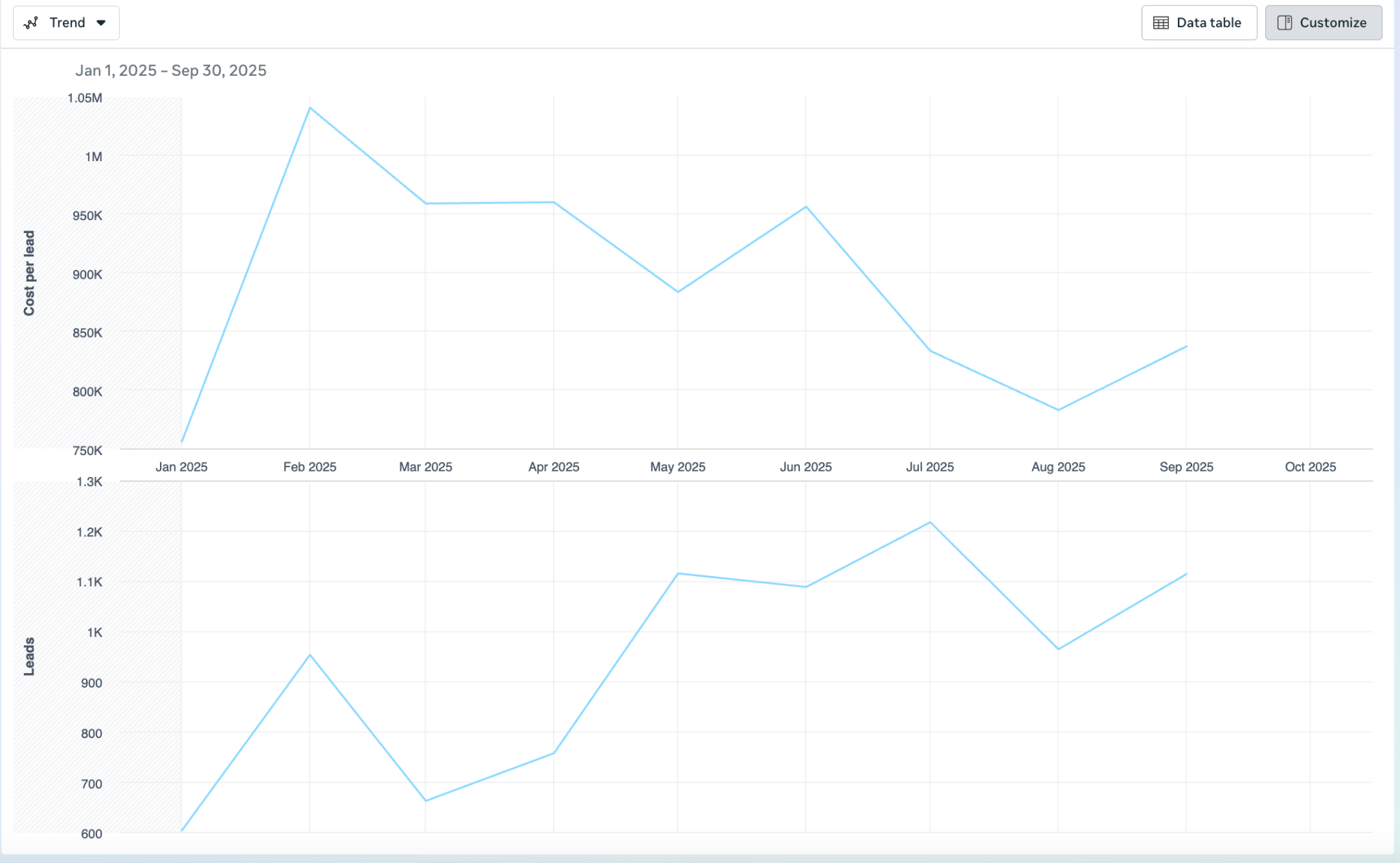
Monthly leads moved from roughly 600 to more than 1,100 while September cost per lead finished below the February peak. Values are rounded from the source record.
The limitations matter. The case does not disclose spend, programme mix, lead-to-enrolment rate, revenue, contribution, attribution settings or a controlled counterfactual. It cannot prove that one account change caused the result, that every lead had equal quality or that another advertiser should expect the same trajectory. It is evidence of an observed operating recovery, not a universal benchmark.
Four lessons I would carry into the next volatile lead account
1. Consolidate the question before consolidating the account
Account simplification only helps when leadership agrees what the campaign is trying to produce. Define the market, offer, usable lead and downstream decision first. Otherwise consolidation merely combines different customer problems into a larger, less readable total.
2. Treat creative as a controlled business hypothesis
A useful creative angle connects one customer problem to one credible promise and one next step. Refreshing assets can restore relevance, but the business should record which angle, audience and destination changed. A constant stream of unlabelled creative makes a good month difficult to explain and repeat.
3. Move budget after evidence, not emotion
Budget changes alter delivery and can change the mix of people reached. I prefer bounded moves with a named review window, a mature outcome and a reversal condition. That keeps the next decision tied to evidence rather than one unusually cheap or expensive day.
4. Return lead quality to the acquisition system
Platforms can count submissions immediately; the business learns quality later. Google Ads distinguishes leads, qualified leads and converted leads so that offline progress can be mapped back to the customer journey. The platform differs from the case channel, but the management principle transfers: optimise towards the deepest reliable business outcome available, not the easiest event to collect.
The Lead Stability Before Scale Gate
I use six checks to decide whether a lead programme has enough control for the next budget step. The owner does not need to operate the advertising platform. The owner does need to approve the commercial definitions, capacity limits and evidence threshold.
One decision worth responding to
Hold the market, problem, promise and next step steady enough to judge demand.
A conversion with business meaning
Separate a valid enquiry from page views, accidental forms, spam and duplicate records.
Angles with named hypotheses
Refresh relevance while recording which customer concern and proof each asset tests.
Bounded changes and review windows
Increase, hold or reduce in interpretable steps with maturity and reversal rules.
Enough capacity to respond well
Confirm routing, response time, qualification and sales ownership before adding volume.
Qualified and converted outcomes return
Reconcile platform leads with CRM, sales and customer records for the same cohort.
The gate does not require perfectly flat performance. Demand, auctions, seasonality and customer behaviour change. It asks whether the business can distinguish normal variation from a broken signal or a material strategic change. That is the difference between volatility the company can manage and volatility that makes scale speculative.
Choose the next move from the evidence pattern
| Observed pattern | Likely issue | Owner decision | Avoid |
|---|---|---|---|
| Lead volume changes with tracking or form anomalies | Signal instability | Hold budget and reconcile source records | Calling measurement failure a demand shift |
| Volume rises; qualification weakens | Audience, promise or conversion definition | Narrow the signal and return sales feedback | Scaling because cost per lead fell |
| Usable leads hold; cost fluctuates inside an agreed range | Manageable market variation | Continue with monitoring and one test | Rebuilding the account every week |
| Lead quality is sound; response capacity is full | Receiver constraint | Hold spend or expand follow-up capacity | Buying leads the team cannot serve |
| Usable volume, progression and economics improve | Supported scale opportunity | Increase in a bounded step with a stop rule | Assuming the next increment will behave identically |
An illustrative owner review
Illustrative example — not client proof or a benchmark
| Same definition and market | Review A | Review B | Interpretation |
|---|---|---|---|
| Valid enquiries | 100 | 125 | Volume increased |
| Qualified by sales | 45 | 59 | Quality did not dilute materially |
| Reached agreed sales stage | 18 | 25 | Downstream evidence moved with volume |
| Team capacity | Available | Available | A bounded scale test may be supportable |
The example keeps the definition and market fixed to show the logic. A real review must account for conversion delay, duplicated leads, programme mix, promotions, attribution, sales capacity and customer value. If those conditions changed, the numbers are not a clean comparison.
For implementation context, review growth partnership services, Meta Ads management, conversion tracking, the original anonymised case, evidence standards and Thomas's direct operator model. If cheap leads are already failing to progress, use the guide to why qualified leads go cold before adding more acquisition pressure.
Sources and evidence notes
Sources and current search results were checked on 1 October 2026. Search priority is qualitative; no unverified keyword volume, universal stability threshold or guaranteed result is claimed. Case metrics are reproduced from approved anonymised portfolio evidence with their period and limitations. The Lead Stability Before Scale Gate, decision matrix and illustrative review are original ThomPerformance practitioner analysis.
Frequently asked questions
What does stable lead generation mean?
It means the business can explain normal variation, maintain a dependable offer and conversion signal, receive leads consistently enough to serve them, and connect submissions to qualification or sales outcomes. Stability is not an identical lead count or cost every day. It is enough control and evidence to make the next budget decision responsibly.
Should a business scale when cost per lead falls?
Not from cost per lead alone. Confirm that lead definitions, markets and attribution are comparable, then review qualification, sales progression, customer value and team capacity. A lower cost can be useful evidence, but it can also reflect weaker intent, a changed audience mix or a period that has not matured.
How long should a lead-generation campaign run before scaling?
There is no universal duration. Wait until the relevant lead and sales outcomes have had time to mature, the tracking is trustworthy and the result is not explained by one promotion or short-lived change. Set the review window and evidence threshold before increasing the budget.
Can more creative fix volatile lead generation?
Creative can repair message fatigue, weak relevance or an insufficient range of customer angles. It cannot fix an unclear offer, broken form, poor follow-up, unsuitable targeting or an unreliable conversion signal. Diagnose the first unstable part of the system before producing more assets.
What should an owner review before increasing lead-generation spend?
Review usable lead volume, qualified rate, sales progression, acquisition cost, response capacity, contribution or customer value, and the changes made during the comparison period. The owner needs one decision record that says what improved, what remains uncertain and what would trigger a hold or reversal.
Stability makes scale a decision rather than a reaction
The case does not say every business can double lead volume or finish below a previous cost peak. It shows a more durable operating principle: define the commercial job, stabilise the conversion signal, label creative hypotheses, bound budget changes, protect response capacity and return qualified outcomes to acquisition.
Which part of your lead system moves without explanation today: the offer, signal, creative, budget, receiver or feedback?