E-commerce scaling solution
You can increase ad spend. That does not mean the economics will scale.
Build the next repeatable pocket of profitable demand instead of asking one audience, product or winning creative to absorb every budget increase.
Best suited to e-commerce brands spending $3K+/month · Direct with Thomas · No retainer pitchScale e-commerce ads only after contribution is stable for comparable cohorts, purchase measurement is trustworthy, the creative pipeline can support more reach and inventory or fulfilment can absorb demand. Increase budget in controlled steps, define the maximum acceptable deterioration and judge each expansion by new-customer contribution—not revenue growth alone.
Client evidence · GA4 e-commerce
Growth was checked against store-level purchase outcomes.
This anonymised GA4 paid-traffic view from a client account in my work portfolio records £104K in total e-commerce revenue and 1.2K purchasers from May to July 2026, with the daily purchaser trend visible alongside revenue.
Inspect the source context →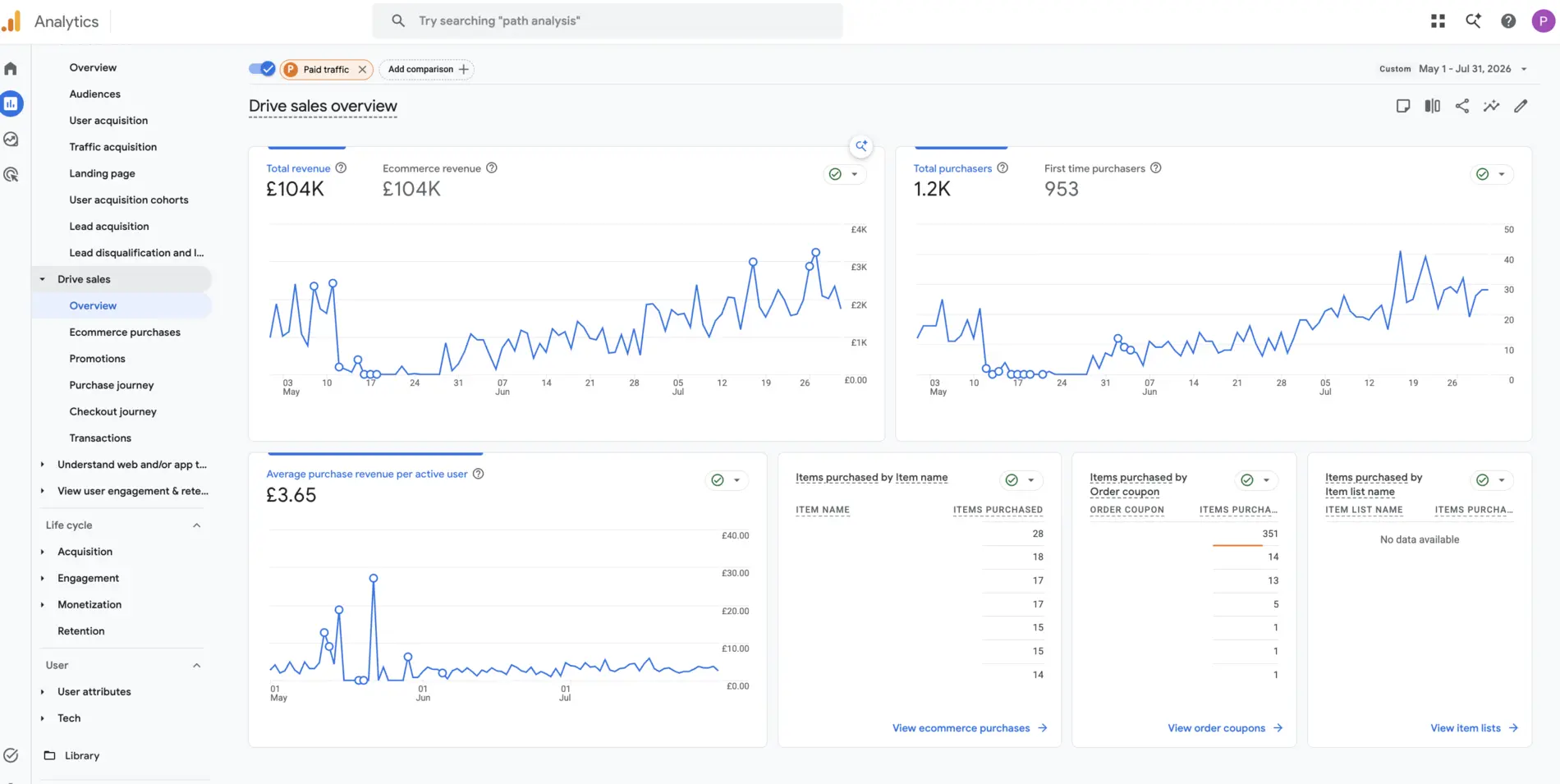
What this looks like
Recognise the symptom before choosing the fix.
CPA jumps after every budget increase
The next pound or dollar of spend reaches weaker demand faster than creative, conversion or customer value can compensate.
One winning creative carries the account
Scale depends on a single angle or product, so frequency and response deteriorate before new creative learns fast enough.
Revenue grows; operations or margin break
Stock-outs, slower delivery, discounting, support load or higher return rates remove the contribution that justified expansion.
What may be underneath
The ad account may be reporting the symptom—not the cause.
The validated market is smaller than the budget target
More spend moves beyond the strongest audience, query, geography or product before another demand pocket is proven.
Learning cannot keep pace with reach
The account expands delivery without enough new hooks, product demonstrations and proof to maintain qualified response.
The scale target ignores marginal contribution
Blended historical ROAS hides the lower return on the next unit of spend and the cost of acquiring more new customers.
The business cannot absorb the demand efficiently
Inventory, fulfilment, customer support, cash conversion and return rates can become the real scale constraint before the campaign does.
How I diagnose it
Trace one commercial chain before changing everything.
- 01
Prove the current economic baseline
Measure new-customer contribution, purchase rate, AOV, refund or return behaviour and cash timing for comparable recent cohorts.
Evidence: A stable baseline with confidence range and allowable CPA. - 02
Map the next scale route
Choose one expansion dimension—budget, audience, market, product, channel or offer—so the result can be interpreted.
Evidence: Expected demand pool, operational requirement and failure condition. - 03
Audit creative and product capacity
Confirm the testing cadence, winning-angle concentration, stock coverage, fulfilment capacity and landing destinations required by the next spend level.
Evidence: Creative runway and operational constraint map. - 04
Scale with explicit guardrails
Increase spend in controlled steps and compare marginal contribution, not only blended account averages. Pause expansion when the defined threshold breaks.
Evidence: Budget step, review window, scale threshold and rollback rule.
Decision map
Match the observed pattern to the first useful action.
| Observed pattern | What it may mean | First decision |
|---|---|---|
| Baseline contribution is unstable | The current system is not ready | Repair economics before adding budget |
| CPA rises but marginal contribution stays positive | Controlled expansion may be working | Continue within the agreed deterioration limit |
| Response falls as reach expands | Creative or audience saturation | Add a new demand angle before more budget |
| Sales grow but delivery or returns worsen | Operational scale constraint | Hold spend until fulfilment economics recover |
| A new market or product passes its cohort gate | Another repeatable demand pocket exists | Scale that route separately and preserve attribution |
This is a diagnostic map, not a universal benchmark. The correct decision depends on your offer, market, buying journey, data quality and starting point.
Free 48-hour written audit
What you receive.
For accounts spending $3K+/month, I review the available media, conversion and commercial context and return the three highest-impact opportunities. No commitment. No retainer pitch.
Request the diagnostic →- Current scale-readiness scorecard
- Marginal contribution and allowable CPA model
- Creative runway and saturation review
- Product, market and operational constraint map
- 90-day controlled scaling plan with rollback rules
Best fit
This diagnosis works when evidence can change a decision.
Strong fit
- E-commerce brands with repeatable purchase volume
- Accounts spending $3K+/month and considering expansion
- Known product margin and fulfilment capacity
- Teams able to produce and test creative consistently
Not designed for
- Stores still searching for initial product-market fit
- Accounts with broken purchase tracking
- Teams using revenue growth as the only scale rule
- A request to guarantee linear performance at higher spend
Practical questions
Questions that change the diagnosis.
How fast should I increase my e-commerce ad budget?
There is no universal percentage. Use smaller controlled steps when purchase volume is low, the sales cycle is delayed or the account depends on few creatives. Define the review window and acceptable marginal CPA before each increase.
Why does CPA increase when I scale?
Additional spend often reaches weaker audiences, placements, products or markets. It can also accelerate creative fatigue and expose onsite or operational constraints. The key question is whether marginal contribution remains positive within your limit.
Should I duplicate campaigns to scale?
Duplication can create another budget container, but it does not create new demand and can fragment learning or overlap audiences. Choose the scale route based on the actual constraint rather than a universal account tactic.
What should be stable before scaling paid ads?
Purchase tracking, product margin, fulfilment, recent cohort contribution, creative production and the main landing path should be reliable enough that a performance change can be diagnosed and acted on.