B2B lead quality solution
Your leads are not just a sales problem. They are a signal problem.
Find where targeting, message, form design and conversion feedback teach Google, Meta or LinkedIn to acquire the wrong response.
Best suited to B2B teams spending $3K+/month · Direct with Thomas · No retainer pitchTo improve B2B lead quality, define the commercial outcome first, trace one recent lead cohort through reachability, fit, sales acceptance and opportunity creation, then return the furthest reliable outcome to campaign reporting. Do not scale a cheaper lead source until downstream quality is visible.
Client evidence · Meta Ads
Optimising beyond the form lead.
In this anonymised client account from my work portfolio, performance was tracked against submitted applications—a deeper outcome than an initial lead. The dashboard records application volume and cost per submitted application from January 2025 to July 2026.
Inspect the source context →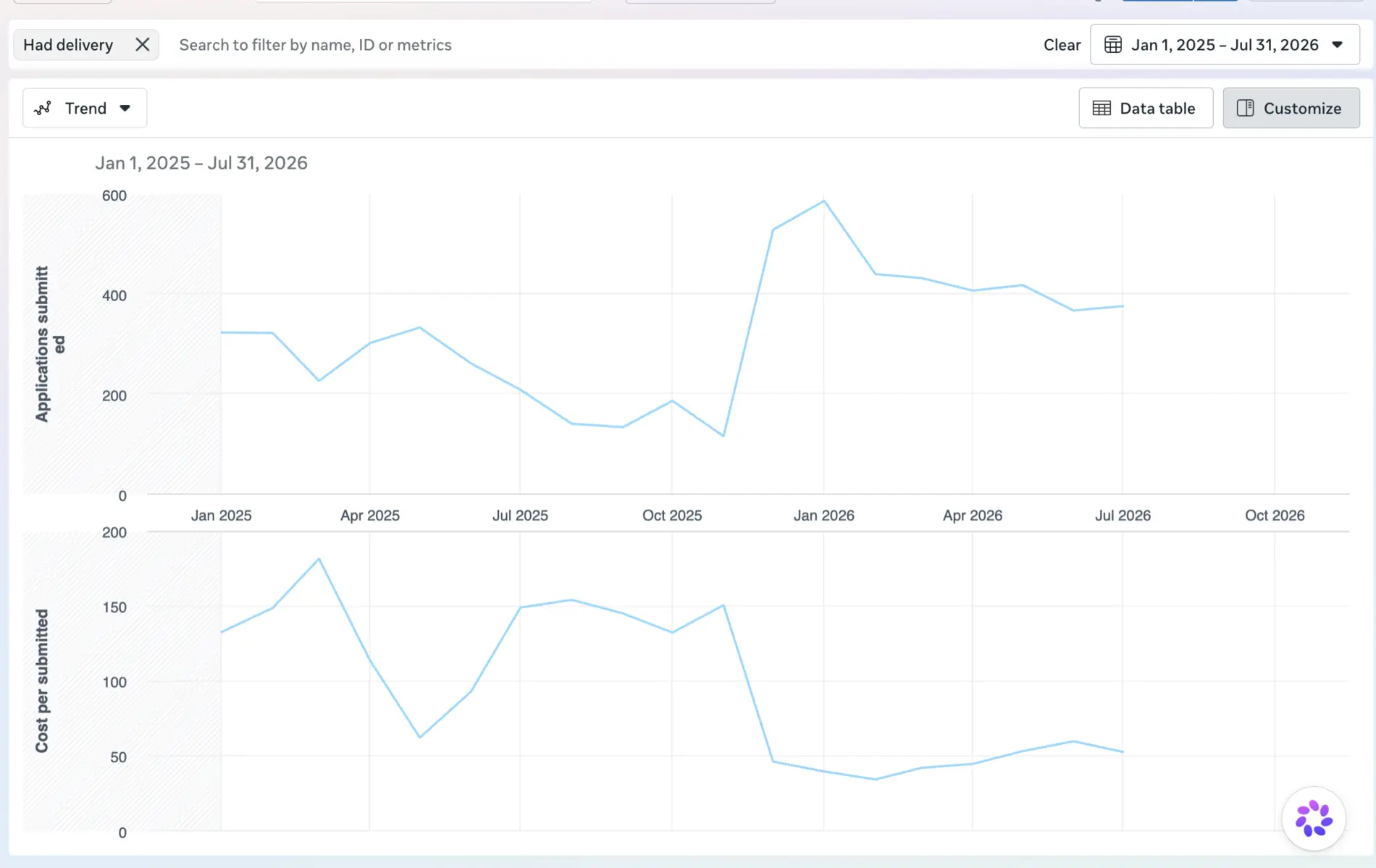
What this looks like
Recognise the symptom before choosing the fix.
Sales rejects most paid leads
The account reports conversions, but rejection reasons such as wrong geography, company size, need or timing are not connected to acquisition decisions.
Cheap campaigns attract weak intent
A low-friction form or broad promise creates response volume while the platform learns only who is likely to submit—not who can buy.
Lead quality is discussed, not measured
Marketing and sales use different definitions, so neither team can compare sources or identify the first point where commercial value disappears.
What may be underneath
The ad account may be reporting the symptom—not the cause.
The platform receives the wrong definition of success
Every form submission is treated equally even when the CRM shows large differences in reachability, fit and sales progression.
The promise attracts curiosity rather than buying intent
Creative and landing-page copy make the response easy but do not name the problem, boundary or commitment that separates a buyer from a browser.
The form collects data without improving the next decision
More fields do not automatically improve quality. Each question should change routing, qualification or the sales conversation.
CRM outcomes arrive too late—or never return
Campaign teams keep optimising against platform-only data because rejection reasons and opportunity stages are incomplete, inconsistent or inaccessible.
How I diagnose it
Trace one commercial chain before changing everything.
- 01
Define one shared quality ladder
Write explicit rules for valid lead, reachable lead, fit, sales accepted, opportunity and customer. Keep the names aligned across marketing, sales and CRM.
Evidence: Stage definitions, required fields and controlled rejection reasons. - 02
Reconcile a recent cohort
Match source, campaign and creative to the furthest trustworthy CRM outcome. Separate genuinely poor quality from missing follow-up or missing data.
Evidence: Contact rate, fit rate, sales-acceptance rate and cost per accepted lead. - 03
Locate the first commercial break
Repair the earliest weak stage before rebuilding the entire account. The correct intervention may be message, validation, routing, response time or optimisation signal.
Evidence: A stage-by-stage loss table with a named owner for each failure. - 04
Return only reliable outcomes
When definitions and volume are stable, send qualified or converted outcomes back to Google, Meta or LinkedIn where the platform supports it.
Evidence: Event delivery, match diagnostics, deduplication and weekly volume checks.
Decision map
Match the observed pattern to the first useful action.
| Observed pattern | What it may mean | First decision |
|---|---|---|
| Many invalid or unreachable contacts | Capture or verification failure | Improve validation and response operations before changing targeting |
| Valid contacts, weak commercial fit | Audience, message or offer mismatch | Tighten the promise and qualification boundary |
| Good fit, low sales acceptance | Definition or handoff conflict | Agree acceptance rules and response ownership |
| Accepted leads, few opportunities | Intent, discovery or proposition weakness | Review calls and objections before scaling media |
| Higher CPL, better opportunity cost | Quality has improved | Protect the commercial economics even if CPL looks worse |
This is a diagnostic map, not a universal benchmark. The correct decision depends on your offer, market, buying journey, data quality and starting point.
Free 48-hour written audit
What you receive.
For accounts spending $3K+/month, I review the available media, conversion and commercial context and return the three highest-impact opportunities. No commitment. No retainer pitch.
Request the diagnostic →- Lead-quality stage map and shared definitions
- Campaign-to-CRM cohort analysis
- Top rejection reasons by source and message
- Tracking and conversion-signal gap list
- Three prioritised fixes with owners and measurement rules
Best fit
This diagnosis works when evidence can change a decision.
Strong fit
- B2B, software, education and service teams
- Paid media spend of $3K+/month
- A clear offer and a team able to follow up leads
- Access to recent lead or CRM outcomes
Not designed for
- Teams seeking lead volume without sales feedback
- Businesses without a defined offer or conversion action
- DIY training or job-seeker enquiries
- A promise of guaranteed lead or revenue results
Practical questions
Questions that change the diagnosis.
What is a good B2B lead-quality rate?
There is no universal rate that should override your economics. Define the stages consistently, compare similar cohorts and judge each source by cost per sales-accepted lead, opportunity and customer as the data matures.
Should we optimise paid ads for MQLs or SQLs?
Use the furthest reliable event with enough timely volume for learning. An SQL may be commercially stronger but too delayed or sparse; an MQL is useful only when its definition is consistently related to sales acceptance.
Will adding more form questions improve lead quality?
Only if the answers change eligibility, routing or the sales conversation. Extra friction can reduce volume without improving fit, so measure contact, acceptance and opportunity rates after the change.
Can Thomas fix poor lead quality without replacing our CRM?
Usually the first step is to repair definitions, required fields, rejection reasons and feedback flow in the existing system. A platform change is justified only when the current process cannot support the required evidence.