Paid media pipeline solution
The ad platforms report conversions. Your pipeline says otherwise.
Connect channel activity, conversion signals and CRM outcomes so budget decisions are based on qualified opportunities—not the easiest event to count.
Best suited to B2B teams spending $3K+/month · Direct with Thomas · No retainer pitchIf paid ads are not generating pipeline, confirm that the offer reaches a real market problem, define the opportunity stage, reconcile campaigns to CRM outcomes and inspect the conversion path between click and sales acceptance. Scale only when a source creates repeatable qualified opportunities at workable economics.
Client evidence · Education
Paid media connected to enrolment outcomes.
For a leading English education group, I rebuilt acquisition decisions around a Lead → Deal → Enrolment model. The documented client case reports 4,210 leads and 135 October enrolments; this image shows the underlying Google Ads account view.
Read the full client case →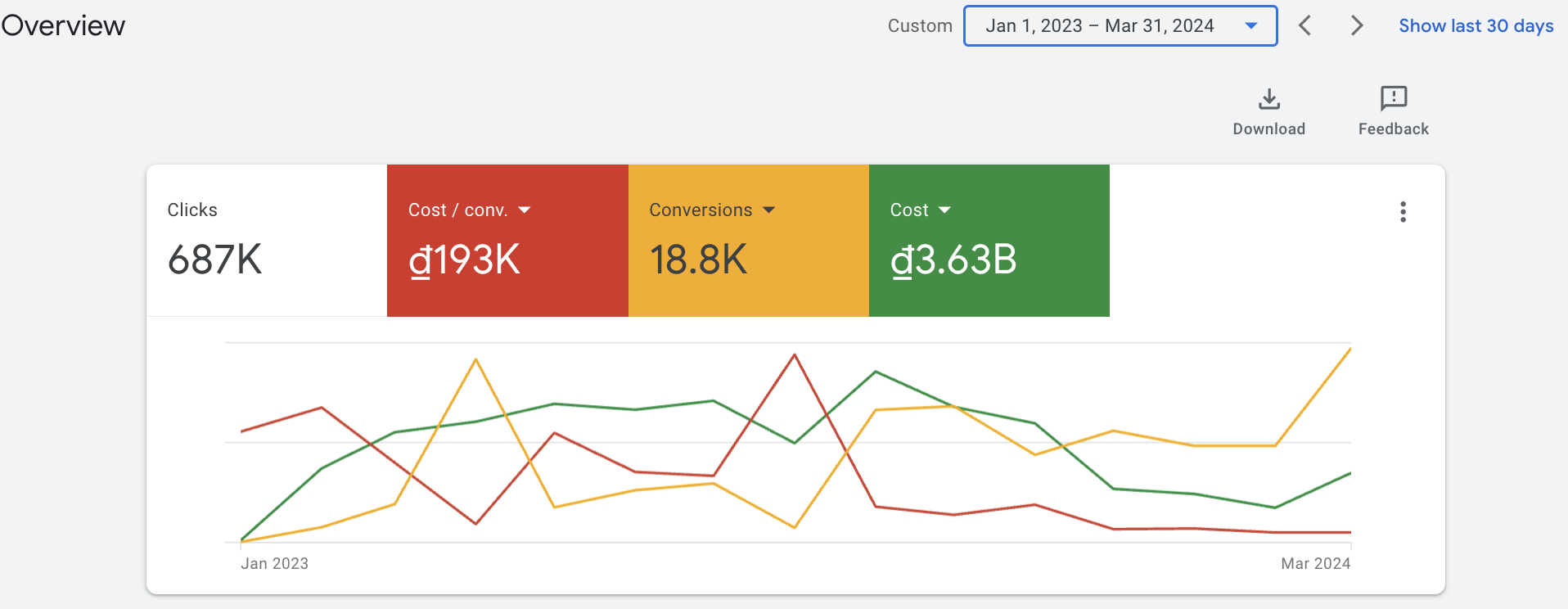
What this looks like
Recognise the symptom before choosing the fix.
Dashboards are green; pipeline coverage is weak
Channel reports improve while sales cannot identify opportunities or revenue influenced by the same campaigns.
Nobody can explain which campaign deserves more budget
Source and campaign data break between forms, CRM stages and offline outcomes, leaving decisions anchored to CPL or last-click platform reports.
Scaling increases activity, not commercial movement
The account expands audiences and spend before validating offer, qualification, landing-page progression and revenue signal.
What may be underneath
The ad account may be reporting the symptom—not the cause.
The campaign captures attention without an urgent problem
Targeting can be technically correct while the offer lacks a specific commercial reason for the buyer to act now.
Campaigns optimise for a proxy that is too far from pipeline
Form fills, page views or low-value actions receive budget because they are frequent and easy to measure.
The path loses context between ad and sales handoff
Message, landing page, capture, follow-up and qualification operate as separate assets rather than one buyer journey.
CRM outcomes cannot be trusted or attributed
Missing source fields, inconsistent stages and delayed updates prevent a defensible view of cost per opportunity and pipeline created.
How I diagnose it
Trace one commercial chain before changing everything.
- 01
Validate demand and offer
Identify the buyer, problem, trigger, proof and next commitment. Separate demand capture from demand creation instead of expecting every channel to perform the same role.
Evidence: Search terms, creative-response patterns, buyer interviews and sales objections. - 02
Define the opportunity unit
Agree what must be true before a record enters qualified pipeline. Exclude raw leads and marketing engagement from opportunity value.
Evidence: Stage entry rules, value method, owner and timestamp. - 03
Reconcile spend to CRM cohorts
Join source, campaign and creative with sales acceptance, opportunity creation, pipeline value and customer outcomes for comparable cohorts.
Evidence: Cost per opportunity, pipeline per dollar and cohort maturation. - 04
Repair the smallest useful layer
Fix the highest-confidence constraint first: demand, account architecture, landing path, tracking, CRM process or feedback to ad platforms.
Evidence: One owner, one decision metric and a defined review date.
Decision map
Match the observed pattern to the first useful action.
| Observed pattern | What it may mean | First decision |
|---|---|---|
| Clicks but few relevant responses | Demand, audience or offer problem | Test the commercial problem and message before adding spend |
| Leads but few accepted by sales | Qualification or signal problem | Align definitions and optimise toward a stronger outcome |
| Accepted leads but no opportunities | Conversion, discovery or value proposition problem | Inspect the full buyer and sales path |
| Opportunities exist but attribution is missing | Measurement architecture problem | Repair CRM source capture and offline outcome reporting |
| Pipeline grows at workable economics | A repeatable acquisition path exists | Scale in controlled steps and monitor cohort quality |
This is a diagnostic map, not a universal benchmark. The correct decision depends on your offer, market, buying journey, data quality and starting point.
Free 48-hour written audit
What you receive.
For accounts spending $3K+/month, I review the available media, conversion and commercial context and return the three highest-impact opportunities. No commitment. No retainer pitch.
Request the diagnostic →- Demand-to-revenue growth-gap map
- Campaign and conversion-action audit
- CRM stage and attribution review
- Spend-to-opportunity cohort scorecard
- Top three recovery actions and a 90-day measurement plan
Best fit
This diagnosis works when evidence can change a decision.
Strong fit
- B2B, education, software and professional-service teams
- Businesses with an established offer and sales owner
- Paid media spend of $3K+/month
- Leadership that wants pipeline-level accountability
Not designed for
- Businesses evaluating ads only by traffic
- Teams without access to sales outcomes
- A request to guarantee pipeline or revenue
- Organisations seeking a large agency handoff
Practical questions
Questions that change the diagnosis.
What counts as qualified pipeline?
A record should enter qualified pipeline only when it meets your explicit fit and opportunity criteria, has a credible next commercial step and carries a defensible value. Raw leads and marketing engagement are not pipeline.
Which metric should replace CPL?
Do not remove CPL; move it down the hierarchy. Use cost per sales-accepted lead or opportunity while the cohort matures, then customer acquisition cost, pipeline created and revenue where the data is reliable.
Can paid ads work with a long B2B sales cycle?
Yes, but reporting must use cohorts and leading commercial stages. Comparing new leads with older closed opportunities produces false conclusions about channel performance.
Does this require HubSpot or Salesforce?
No specific CRM is required. The business does need stable stages, source capture, ownership and a way to export or inspect outcomes. The diagnosis starts with the existing operating system.