
Scale the enquiry system, not the form count
An education owner can approve more advertising and still make the pipeline less predictable. More budget may expose a weak programme message, fragmented measurement, tired creative, slow admissions response or an offer that attracts curiosity rather than genuine intent.
My verdict is to increase spend only after the current enquiry path behaves within an agreed range. Cost per lead (CPL) is the advertising cost divided by form submissions or other defined responses. It is useful for monitoring delivery, but it cannot show whether the person is eligible, reachable, ready to apply or commercially suitable.
This article is distinct from the qualified student enquiry guide, which defines a viable prospect, and the lead-to-enrolment case, which connects platform activity to verified student outcomes. This case addresses a narrower owner decision: how to grow enquiry volume without accepting avoidable cost volatility.
What the documented education case shows
In an anonymised 2025 engagement for a national education brand in Vietnam, lead delivery was volatile. My recorded work consolidated the account around clearer conversion signals, refreshed creative by buying angle, and moved budget towards combinations producing both volume and usable lead quality.
The approved Meta account trend covers January to September 2025. Monthly lead volume moved from roughly 600 in January to more than 1,100 in September. CPL peaked at about VND 1.04 million in February and finished September at about VND 0.84 million.
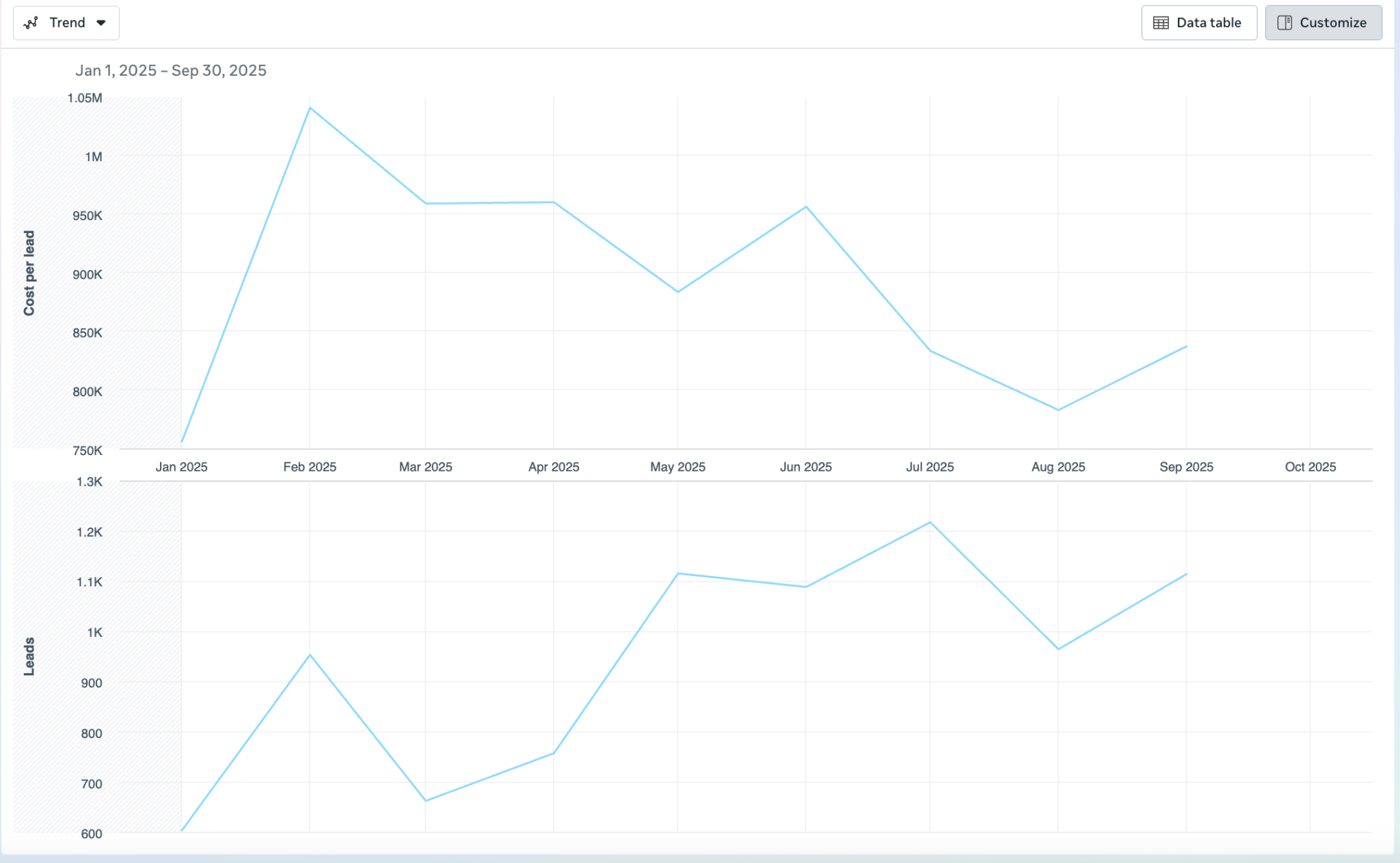
Values are rounded from the source dashboard. Brand, programme mix and commercially sensitive rows are withheld.
The evidence has boundaries. It reports platform leads and CPL, not applications, enrolments, revenue, margin or incrementality. It does not isolate creative, structure and budget allocation from seasonality, programme demand, admissions work or wider client decisions. The appropriate claim is that lead volume and platform cost moved in a favourable direction during the recorded work—not that one tactic caused profitable growth.
The Stable Enquiry Scale Gate
I use six questions to decide whether an education business has earned the next budget increase. Leadership owns the commercial answers; the marketing partner and admissions team own the evidence.
Is a usable enquiry defined?
Agree the minimum programme, location, timing and eligibility information admissions needs.
Is the record consistent?
Use the same conversion definition, date scope and programme labels before comparing periods.
Does the message self-qualify?
State who the programme is for, what decision comes next and important constraints.
Can admissions respond well?
Assign every enquiry, record the outcome and protect response quality as volume rises.
Is performance repeatable?
Judge several comparable review periods, not one unusually cheap day or campaign.
Is the next loss acceptable?
Set the maximum budget step, CPL range and downstream deterioration that trigger a hold.
The gate is intentionally commercial. It does not ask an owner to edit campaigns. It asks whether the business can explain the signal, service the demand and stop before higher spend turns uncertainty into a larger loss.
Choose the next move from the evidence
| Observed pattern | Likely constraint | Owner decision | Avoid |
|---|---|---|---|
| Enquiries rise; CPL stays inside range | Potentially stable acquisition | Check qualification and application progression before another step | Calling form volume profitable growth |
| Enquiries rise; admissions contact rate falls | Routing or follow-up capacity | Hold spend and repair ownership | Blaming the channel for an unworked queue |
| CPL falls; usable-enquiry rate falls faster | Weak relevance or easy conversion | Tighten the promise and minimum qualification | Optimising to the cheapest name |
| One programme is stable; others are volatile | Offer or demand differences | Scale the proven programme separately | Hiding unlike courses in one average |
| Volume and downstream progression hold | Supported next step | Increase budget in a recorded increment with a stop rule | Multiplying spend across every programme |
Niche notes that enquiry campaigns need pre-agreed goals and that volume can attract people with no enrolment intent. A separate 2025–2026 education case from MTA Digital similarly compares complete enrolment cycles and like-for-like periods rather than one month. Both reinforce the same owner principle: stability depends on definitions and comparable evidence, not a universal CPL benchmark.
The Spend-to-Stable-Enquiry Evidence Loop
Run the loop for one programme or closely related programme group. First, reconcile spend, enquiries and admissions outcomes for the same period. Second, identify the first material break: delivery, enquiry fit, contact, qualification or application. Third, change one meaningful variable. Fourth, wait for the agreed decision window. Fifth, compare downstream quality and economics. Sixth, record Scale, Hold, Repair or Stop.
Illustrative example—not client proof or a benchmark
| Review period | Enquiries | Usable enquiries | Applications | Decision |
|---|---|---|---|---|
| Current budget | 100 | 60 | 18 | Baseline |
| Controlled increase | 125 | 76 | 22 | Scale only if economics and capacity remain acceptable |
| Volume-only increase | 150 | 65 | 17 | Hold and repair relevance or follow-up |
The example shows why a lower headline CPL can conceal weaker value. Replace every number with the business's own CRM and finance evidence. Do not combine programmes with different eligibility, price, start date or sales cycle merely to make the average appear stable.
Consent and data handling also belong in the scale decision. UK government guidance requires businesses to check that people want direct marketing and to make opt-out straightforward. Requirements differ by market and channel, so obtain appropriate legal advice rather than treating a form submission as unlimited permission.
For implementation, connect Meta Ads management, landing-page support and conversion tracking to one admissions outcome. Review the original case context, evidence standards, Thomas's direct operating model and the guide to stabilising lead generation before scaling.
Sources and evidence notes
Sources and current search results were checked on 5 November 2026. Case metrics are reproduced from an approved anonymised platform record with the limitations stated above. No enrolment, profit, incrementality or universal CPL claim is made. The Stable Enquiry Scale Gate, decision matrix and Spend-to-Stable-Enquiry Evidence Loop are original ThomPerformance practitioner analysis.
Frequently asked questions
What does this education lead-generation case prove?
The approved Meta account record shows monthly lead volume moving from roughly 600 in January to more than 1,100 in September 2025, while September cost per lead was below the February peak. It documents an observed account trend and Thomas Ho's recorded work, not enrolments, profit, incrementality or a guaranteed result.
What is a stable cost per lead for an education business?
There is no universal stable price. Stability means the business can explain normal variation, compare like-for-like programmes and periods, and keep the cost inside an economic boundary based on qualification, application and enrolment yield. A cheap form submission can be expensive if admissions cannot progress it.
Should an education provider optimise for more enquiries or better quality?
Neither in isolation. Set a minimum usable-enquiry definition, then grow volume while monitoring progression. If volume rises but contact, qualification or application rates deteriorate, hold spend and repair the message, route or follow-up before pursuing more names.
How quickly should an education business increase advertising spend?
Increase in controlled steps only after the current programme, message, measurement and admissions handoff produce repeatable evidence. The right interval depends on enquiry volume and the decision cycle. Record the budget step, expected range and stop rule before approving it.
Does lower cost per lead mean the campaign is more profitable?
No. Cost per lead measures the price of the initial response. Profit depends on suitable enquiries progressing through application and enrolment at an acceptable acquisition cost, with programme capacity, refunds, discounts and delivery economics included.
Make the next budget step earnable
The case shows that an education account can move towards more enquiry volume and lower platform cost, but responsible scaling starts with the limits. Define usable demand, compare like-for-like periods, protect admissions capacity and judge the next increment by progression—not form count alone.
Which part of the enquiry path becomes less predictable when your budget increases?