
More education leads are not automatically more growth
I worked with an established, multi-program English education group that needed one view from paid click to lead, deal and enrolment. I rebuilt acquisition decisions around those stages, separated the jobs of Google, Meta and TikTok, connected reporting with the customer-management system and used downstream quality—not the cheapest form fill—to guide budget.
My verdict is simple: enrolment is a shared operating outcome. Marketing influences discovery and expectation. Admissions confirms eligibility, fit and intent. Programme availability, timing, fees and the student decision determine whether a qualified prospect starts.
This is distinct from my guide to generating qualified student enquiries. This case explains how an owner should govern the evidence after acquisition starts, so lead growth does not conceal weak progression or an admissions bottleneck.
What the documented case proves—and what it does not
The approved case records 4,210 leads and 135 enrolments in October. Lead volume in the same month increased 280% year over year. These are useful operating facts because the reporting model connected campaign activity with an explicit enrolment stage.
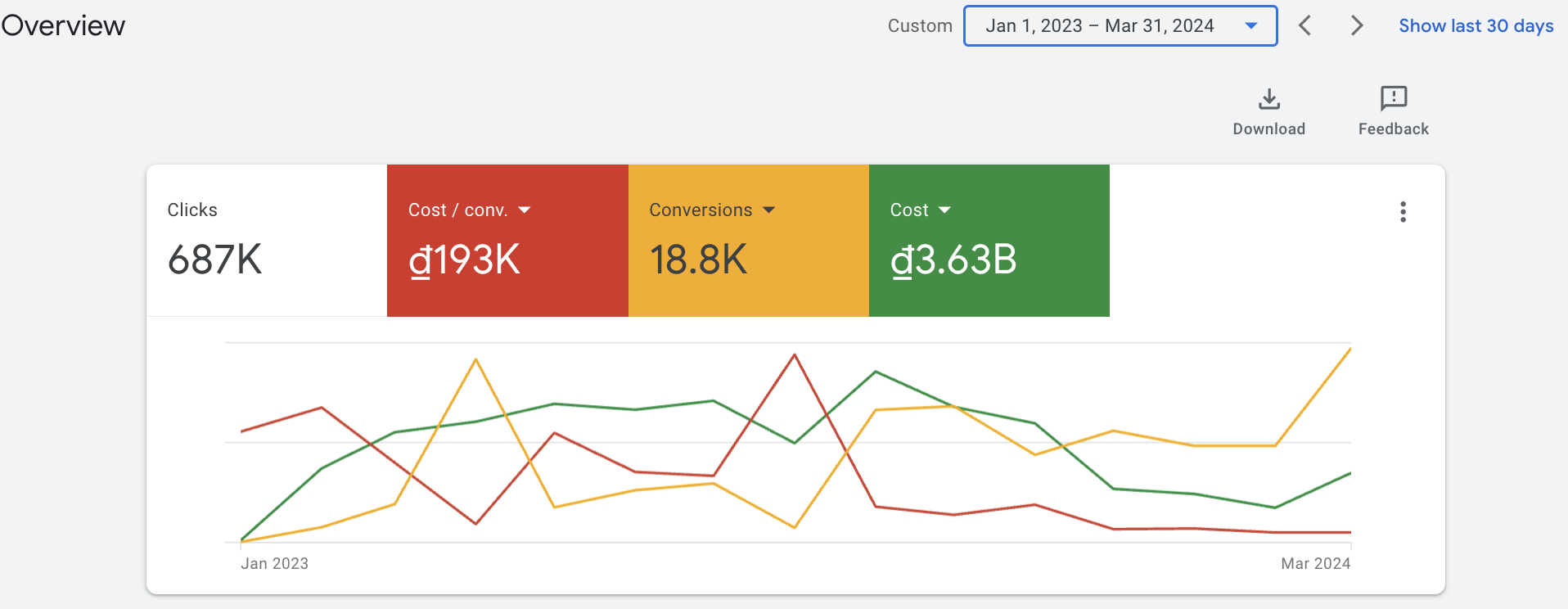
Google Ads account overview, January 2023–March 2024; dashboard labels are shown as captured. The approved case separately records 4,210 leads and 135 enrolments in October, with lead volume up 280% year over year in the same month. Client identity is withheld.
The numbers do not disclose spend, revenue, margin, programme mix, capacity, lead eligibility or the attribution window. They cannot prove incremental enrolments, a universal conversion rate or an ROI benchmark. They show why leadership must inspect progression instead of treating a platform conversion as a student.
UK CAP guidance says objective university comparisons need documentary evidence, a clear basis and necessary qualifications. The wider commercial principle is sound: acquisition messages should make the meaning and evidence behind outcomes clear.
Four lessons I would carry into the next education account
A lead, contacted prospect, eligible prospect, deal or application and enrolled student need written entry rules.
A blended total can hide differences in demand, entry criteria, price, intake timing and available seats.
Reason codes for no contact, ineligibility, timing, affordability and lost choice help marketing correct the promise or route.
Lead cost supports diagnosis; enrolment progression and economics support the investment decision.
Google Analytics now separates new, qualified and converted lead events in its lead-acquisition reporting. An education business can name the stages differently, but the principle is useful: top-of-funnel acquisition and later commercial outcomes should remain visible rather than collapsing into one “conversion” count.
When qualified prospects go quiet, use the lead-progression diagnosis before blaming source quality. When leadership cannot tell whether marketing works at all, start with the owner measurement framework.
The six-stage Enrolment Evidence Spine
I use one decision spine to keep the handoffs visible. It gives acquisition, admissions and leadership one record of what happened without prescribing a specific system.
Record the promise
Keep channel, campaign, message, landing page, programme and intake beside the enquiry.
Create one record
Deduplicate contacts, preserve consent and timestamp the first request for information.
Own the response
Assign the next action and distinguish unreachable records from prospects who actively decline.
Confirm fit
Record entry requirements, location, schedule, language level, affordability and decision timing where relevant.
Show progression
Use a meaningful deal, application or counselling stage with an owner and reason for loss.
Close the loop
Verify the student start, programme, cohort and agreed economic evidence before reallocating budget.
The leadership job is to approve the definitions, keep exceptions visible and stop teams changing the denominator to defend performance.
Use the evidence pattern to choose the next action
| Observed evidence | Likely constraint | Owner decision | Marketing implication |
|---|---|---|---|
| Leads rise; eligible prospects and enrolments stay flat | Audience, promise, programme fit or attribution | Hold broad scaling and inspect rejection reasons | Narrow the message and route budget toward demonstrated fit |
| Eligibility is healthy; few prospects reach a decision stage | Response, counselling or process ownership | Repair the admissions handoff | Preserve source context and measure progression time |
| Applications or deals progress; enrolments fall | Offer proof, fees, timing, capacity or competitor choice | Investigate by programme and cohort | Answer the real decision barrier rather than buying more reach |
| One programme enrols well but has limited capacity | Operational constraint | Protect capacity and test the next suitable offer | Do not let one blended efficiency number overfund a full cohort |
| Source or stage data is incomplete | Measurement failure | Delay the winner declaration | Reconcile records before changing bidding or budget |
This matrix directs the next investigation; it does not create causation from correlation. Compare cohorts with a reasonable decision window and keep programme economics beside enrolment counts.
The same distinction underpins cost per lead versus pipeline and the decision about running paid ads before a sales or admissions receiver is ready.
A 30-day owner reporting reset
Define
Write the stage dictionary, owners, programme fields, cohort window and loss reasons. Record known limitations.
Reconcile
Sample records from platform lead through admissions outcome. Fix duplicate, missing-source and timestamp problems.
Review
Compare sources by contact, eligibility, progression and enrolment—without treating immature cohorts as losses.
Decide
Choose one message, handoff or allocation change; define the evidence that will keep, revise or stop it.
Thirty days is enough to repair definitions and expose a missing handoff; it may not be enough for a full enrolment cycle. The review window should match the provider’s intake and decision timeline.
For support, review my growth partnership services, Google Ads work, Meta Ads work, AI-assisted customer insight, the full education case context, the evidence standards and direct operator model.
Sources and evidence notes
Sources and current search results were checked on 3 September 2026. Search priority is qualitative; no unverified search volume or universal conversion benchmark is claimed. The Enrolment Evidence Spine and decision matrix are original practitioner analysis. Case figures come from approved anonymised portfolio evidence and retain the stated scope and limitations.
- ThomPerformance: anonymised education acquisition and enrolment case
- Google Analytics: lead acquisition report and lead-stage events
- Google Ads: qualified and converted lead stages
- ASA/CAP: evidence and qualification for university comparative claims
- ASA/CAP: misleading advertising guidance, updated 12 March 2026
Frequently asked questions
What is a good lead-to-enrolment conversion rate?
There is no responsible universal rate. Programme type, entry requirements, price, geography, start date, lead definition and attribution window all change the denominator. Establish a cohort-consistent baseline for each programme, then compare progression, enrolment value and capacity using the same definitions.
Should education marketing be measured by cost per lead?
Cost per lead is an acquisition diagnostic, not the commercial verdict. Review contactability, eligibility, application or deal progression, enrolment and programme economics beside it. A cheaper source can be worse if its prospects rarely meet admissions requirements or start a course.
How should marketing and admissions share lead data?
Agree one stage dictionary, one record owner and a small set of reason codes. Marketing needs timely feedback on contact, eligibility, progression and enrolment. Admissions needs the source, programme promise and enquiry context. Both teams should review exceptions before changing spend.
Can paid advertising generate student enrolments?
It can create and capture demand, but advertising alone does not enrol a student. Programme fit, truthful claims, landing-page clarity, response, counselling, admissions requirements, timing and payment all affect the outcome. Judge paid media within that complete decision journey.
What does this education case study prove?
It documents 4,210 leads, 135 October enrolments and a 280% year-over-year increase in October lead volume under a Lead-to-Deal-to-Enrolment operating model. It does not disclose revenue, margin, spend, programme mix or incrementality, so it is not a universal ROI benchmark.
Make enrolment evidence the shared language
The most valuable part of this case is not a headline ratio. It is the discipline of connecting the acquisition promise with admissions progression and a verified student outcome. That creates better budget decisions and a clearer account of where growth is really constrained.
Which stage is missing from your current report: contact, eligibility, progression, enrolment or programme economics?