Market the route the operation wants to renew
More enquiries do not automatically create a stronger contract portfolio. An account can look attractive because it has multiple sites or high collection frequency, yet weaken contribution through awkward geography, unsuitable containers, narrow access windows, contamination, specialist handling, volatile disposal costs or unclear records.
The owner’s decision comes before the channel decision: which sites and service conditions should marketing bring into the business? That answer should shape search targeting, landing pages, qualification, site assessments and pricing before more budget or sales capacity is approved.
This is a commercial growth guide, not legal, environmental, safety or transport advice. Waste classification, storage, carriage, transfer, treatment and disposal obligations depend on the waste, contract and jurisdiction. Competent people should verify the applicable rules and permits before service begins.
The STREAM Contract Fit Gate
Use six connected checks before directing more demand towards a commercial waste offer. A gap can be assessed, repriced, redesigned or referred—but it should never disappear inside an optimistic lead count.
Waste the team can handle
Identify types, volumes, composition, contamination risk, variability and any specialist classification or handling need.
Geography that strengthens a route
Compare site location, nearby customers, collection frequency, disposal destination and whether the account densifies or fragments service.
Evidence both sides can keep
Define descriptions, authorisations, transfer records, weights, exceptions and who owns each compliance or customer record.
Containers and vehicles that fit
Match material, volume, lifting method, container footprint, vehicle access, segregation and collection frequency to real equipment.
A service window the route can keep
Check gates, loading areas, keys, hours, traffic, site rules, safety conditions, missed-collection process and decision-maker availability.
Economics that survive delivery
Price collection, travel, handling, disposal, equipment, documentation, exceptions, service recovery and renewal work using actual costs.
STREAM gives marketing and operations one definition of a suitable contract, before constraints surface after the proposal.
Help the buyer recognise fit before requesting a quote
Generic claims such as “all waste, anywhere” weaken qualification. Buyers need to know whether the provider understands the site, has suitable equipment, can meet the service window and will return usable records.
| Buyer question | Evidence to make visible | Boundary to state |
|---|---|---|
| Do you serve sites like ours? | Named customer categories, service area, waste streams, container options and approved evidence | Do not imply every material, location or collection condition is accepted |
| What happens before pricing? | Information requested, site or waste assessment, access review, outputs and next decision | Do not fix an unknown stream or site burden from a short form alone |
| What is included? | Container, collection frequency, records, weights, exception handling and customer responsibilities | Separate standard service from contamination, overload, abortive visit or special treatment |
| How will we manage change? | Named contacts, review cadence, volume or stream changes, service evidence and escalation route | State which changes require reassessment, approval or repricing |
In England, businesses must minimise, sort and store waste safely, complete transfer documentation and check that their carrier is registered. The duty-of-care code also requires an accurate written description. These duties show why marketing should not promise a simple price while stream and record needs remain unknown; operators elsewhere should follow local requirements.
Price the collection system between assessment and renewal
The contract price must fund more than a vehicle arriving. Include containers, mobilisation, route time, access, records, disposal or treatment, contamination, failed access, service recovery, account review and equipment replacement. Use actual costs and risk rules; this guide sets no universal margin or route-density benchmark.
Research on Waste Management’s industrial collection operation describes recurring service with varied customer requirements, containers, waste types and disposal costs. A distant high-revenue account can therefore be less attractive than suitable sites that strengthen an existing route.
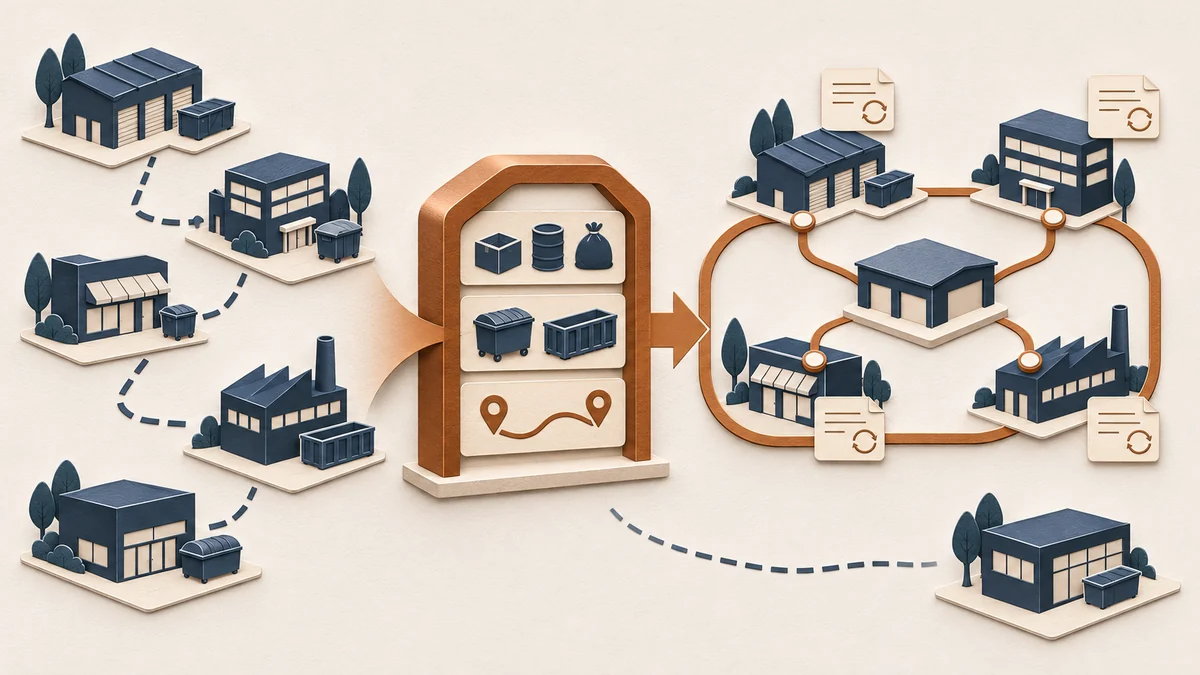
Use one Site-to-Renewed-Route Evidence Loop
The Loop does not replace waste, transport or financial records; it shows leadership whether demand becomes suitable, delivered and renewable service.
How the site arrived
Search, referral, tender, partner, outbound contact or an existing customer relationship.
What the site produces
Streams, volumes, containers, geography, access, frequency, records and buyer responsibility.
What both sides accepted
Collections, equipment, assumptions, exclusions, documentation, price and change process.
What was mobilised
Service pattern, resources, disposal destination, exceptions and the effect on route capacity.
What delivery proved
Collections, weights where available, contamination, missed service, recovery and open action.
What value the account retained
Renewal, expansion, collected revenue, service cost, contribution and capacity decision.
Hypothetical example—not a customer result: a twelve-site hospitality group requests one price but has mixed streams, inconsistent bin stores and no common volume record. The correct next step is a structured multi-site assessment and representative service design, not a fixed quote based only on site count.
The U.S. Environmental Protection Agency recommends a waste assessment or audit to understand quantity, composition and contamination. That discipline also improves commercial qualification.
Connect the acquisition source through commercial conversion tracking, then let the CRM, route and finance systems own later evidence. Marketing should not count a booked assessment or issued proposal as a contract win.
Choose the next action from fit, not contract size
| Evidence pattern | Owner decision | Next action |
|---|---|---|
| Stream, territory, records, equipment, access and margin align | Pursue | Progress to a properly scoped proposal and mobilisation plan |
| Need is credible, but waste or volume evidence is incomplete | Assess first | Audit representative sites before fixing scope, frequency or price |
| Access, contamination or disposal burden exceeds the assumption | Reprice or redesign | Change container, frequency, exclusions, route or commercial terms |
| One stream or location falls outside authorised or practical coverage | Partner or refer | Define responsibility, records, customer ownership and economics first |
| The account fragments the route or requires an unsustainable promise | Decline | Record the reason and return it to targeting and qualification rules |
Waste Connections’ public filings describe growth in adjacent and contiguous markets, supporting disciplined territory decisions rather than indiscriminate reach. Build decision-focused landing pages; compare the recurring route-contract framework, refrigeration contract guide and lead-stability decision. Review Google Ads services, approved case evidence, evidence standards and Thomas’s operating model.
Frequently asked questions
How can a commercial waste company get more contracts?
Define the waste streams, sites, containers, service area and collection conditions the operation can serve profitably. Market that fit, assess before making a fixed promise, and measure mobilised routes, contribution and renewal rather than enquiries alone.
What makes a commercial waste lead qualified?
A qualified opportunity has a real decision-maker, identifiable sites, known or assessable waste streams, workable geography, suitable equipment and access, a credible start date, and an acceptable purchasing route. Missing waste or service evidence should trigger an assessment, not an automatic quote.
Should a waste company target every business in its service area?
No. A nearby site can still be a poor fit if its waste, access, container, frequency or records do not match the operation. A distant site may work only when it strengthens a route or belongs to a suitable multi-site account.
What should a commercial waste service page include?
Explain the customers, waste streams and geography served; assessment; container and collection options; access; records; exclusions; pricing inputs; and next step. Help a decision-maker recognise fit before requesting a proposal.
How should commercial waste marketing performance be measured?
Track assessed sites, suitable opportunities, scoped proposals, awarded and mobilised contracts, route effect, completed collections, exceptions, contamination, service recovery, collected revenue, contribution and renewal. Leads and clicks explain demand, but they do not prove a contract is serviceable or profitable.
Grow the route portfolio the operation can service and renew
Start with a known stream, workable territory, clear records, suitable equipment, controlled access and a margin that survives delivery. Assess before promising, then return mobilisation, contribution and renewal evidence to the next acquisition decision.
Sources and evidence notes
Primary and authoritative sources and current search results were checked on 6 November 2026. Ahrefs keyword data was unavailable under the connected plan, so topic priority is qualitative; no search volume, ranking, margin, route-density benchmark, renewal rate or client result is claimed. STREAM and the Site-to-Renewed-Route Evidence Loop are original ThomPerformance decision tools.
- GOV.UK: Dispose of business or commercial waste — business duties for minimisation, storage, transfer notes and carrier checks in England.
- GOV.UK: Waste duty of care code of practice — authorised handling, accurate descriptions and written transfer evidence.
- U.S. EPA: Managing and Reducing Wastes in Commercial Buildings — waste assessment and audit guidance.
- INFORMS Journal on Applied Analytics: Dynamic Route Optimization and Automation of Industrial Routes at WM — industrial collection complexity and route decisions.
- Waste Connections 2025 annual report — public operating context on adjacent markets, service expansion and acceptable returns.