Market a controlled cold-chain service, not every breakdown
A busy callout diary can hide a weak contract portfolio. Distant sites, unknown refrigerant charges, obsolete equipment, incomplete records and unlimited response promises can consume specialist capacity without creating renewable value. A large agreement may be commercially worse than a smaller one when its assets, travel pattern or after-hours expectations do not fit the operation.
The owner’s decision comes before the channel decision: which sites and service conditions should marketing bring into the business? The answer should shape targeting, service pages, qualification, surveys and pricing before more advertising or sales activity is approved.
This is a commercial growth guide, not engineering, refrigerant-handling or legal advice. Equipment condition, leak obligations, certification, safe work and maintenance scope must be assessed by competent people under the applicable manufacturer instructions, contract and jurisdiction.
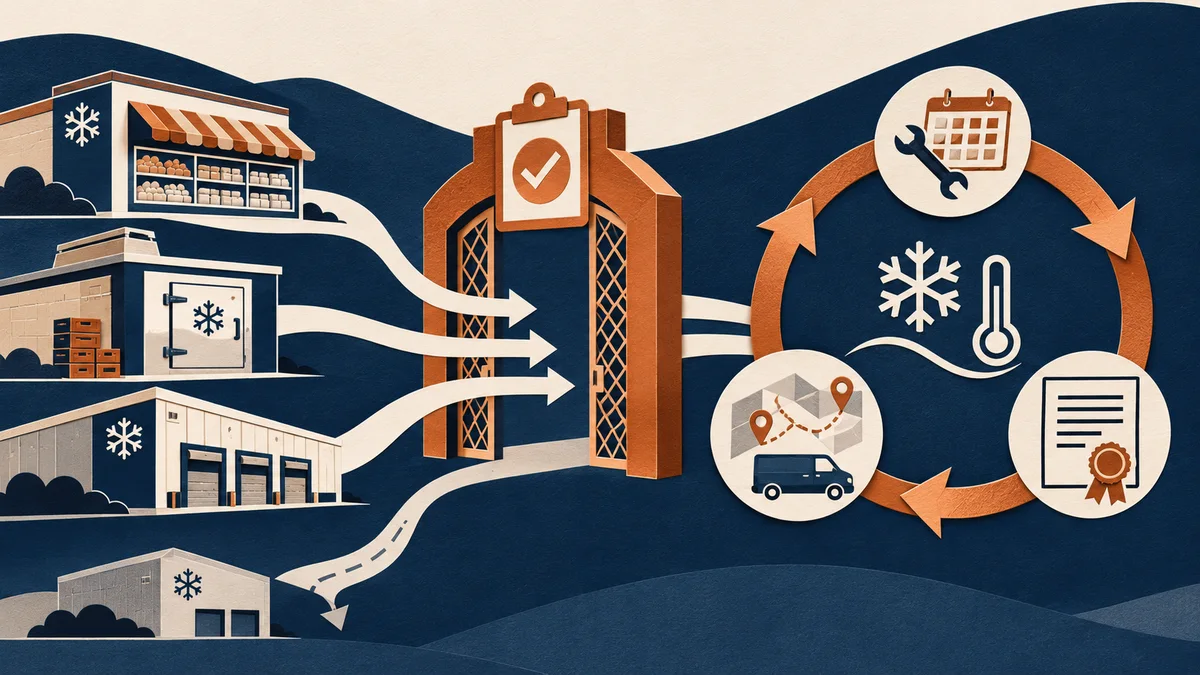
The Cold-Site Contract Fit Gate
Use six connected checks before directing more demand towards a maintenance offer. A weakness can be investigated, repriced or partnered—but it should never disappear inside an optimistic lead count.
A real business consequence
Identify what depends on cooling, the cost and operational effect of failure, the decision-maker and why action matters now.
Equipment the team can understand
Request an asset list, age, refrigerant, charge, condition, service history, controls, alarms and available records.
Certified work with clear evidence
Match the equipment and refrigerant to company and technician competence, required records, verification and disposal duties.
Geography that protects response
Compare site density, travel, access hours, agreed response, after-hours cover and whether the account strengthens or fragments the route.
A promise the operation can keep
Test planned visits, urgent demand, specialist skills, parts exposure, subcontractors, supervision and reporting against real capacity.
A record that can support renewal
Agree how condition, refrigerant work, completed action, open risk, approvals, response and value will be documented.
The commercial value of this gate is focus. It prevents paid search, referrals and tender activity from creating obligations the service operation cannot control.
Help the buyer recognise fit before requesting a visit
Generic claims such as “all refrigeration systems” or “24/7 nationwide service” can increase enquiries while weakening qualification. A food retailer, restaurant group, cold store or facilities team needs to know whether the provider understands the site type, can service the relevant equipment and will leave a usable record after each visit.
| Buyer question | Evidence to make visible | Boundary to state |
|---|---|---|
| Do you serve sites and systems like ours? | Named site categories, equipment scope, geography, certifications and approved evidence | Do not imply competence across every refrigerant, controller, asset or jurisdiction |
| What happens during the first survey? | Records requested, asset verification, access needs, condition review, outputs and next decision | Do not quote an unknown estate as if its asset and response burden were already known |
| What is included in maintenance? | Planned tasks, record updates, leak or condition findings, minor-work boundary and approvals | Separate planned service from parts, major repairs, replacement and emergency attendance |
| How will we control open risk? | Asset register, visit record, outstanding actions, owner responsibilities and review summary | Specify the response commitment, evidence owner and client decisions still required |
In the United States, EPA Section 608 rules require certification for technicians who maintain, service, repair or dispose of relevant equipment. For appliances containing at least 50 pounds of ozone-depleting refrigerant, commercial refrigeration leak-rate triggers and repair or retrofit duties may also apply. In Great Britain, companies servicing stationary refrigeration containing fluorinated gas for others generally need company certification and must retain specified equipment records. Marketing should make the applicable competence and record boundary visible without turning a landing page into legal advice.
Price the service system between the survey and the renewal
The contract price must fund more than scheduled technician time. Include mobilisation, travel, access coordination, asset verification, records, planned work, callout readiness, parts sourcing, specialist support, reporting, quotations, approval follow-up, repeat attendance and service recovery. Use the company’s actual labour, overhead and risk rules; there is no universal maintenance margin in this guide.
Maintenance evidence should also help the customer act. The U.S. Department of Energy’s current guidance points to practical measures such as checking door gaskets and closers and keeping coils clean with unobstructed airflow. Those examples show why a good visit should connect an observed condition to a named action, owner and next review—not merely record attendance.
Use one Site-to-Renewed-Cold-Chain Evidence Loop
The Loop connects marketing with commercial and operational reality. It does not replace engineering or refrigerant records; it tells leadership whether demand is becoming suitable, completed and renewable service.
How the site arrived
Search, referral, tender, partner, emergency call or an existing customer relationship.
What the estate contains
Sites, assets, refrigerants, records, criticality, access, history and buyer responsibility.
What both sides accepted
Planned tasks, exclusions, response, records, pricing assumptions and approval path.
What was delivered
Visits, findings, refrigerant activity, parts, response and the evidence returned.
What changed afterwards
Resolved issues, approved remedials, client actions, open risk and close-out.
What value the account retained
Renewal, expansion, collected revenue, service cost, contribution and capacity decision.
Illustrative example—not a client result: a three-site restaurant group has credible need but no consistent asset register. The correct action is a paid survey and scoped register, not an instant fixed maintenance price. That protects both the buyer and provider from treating unknown legacy equipment as a known service obligation.
Connect campaign source through commercial conversion tracking, then let the CRM and service system own later evidence. Marketing should not count a callout, booked survey or quoted estate as a contract win.
Choose the next action from fit, not urgency
| Evidence pattern | Owner decision | Next action |
|---|---|---|
| Criticality, assets, scope, route and capacity align | Pursue | Progress to a properly scoped survey or proposal |
| Need is credible, but the asset or refrigerant record is incomplete | Survey first | Verify the estate before fixing scope, response or price |
| Legacy risk or response burden exceeds the original assumption | Reprice or redesign | Change scope, exclusions, mobilisation or service level before acceptance |
| One asset, refrigerant or location falls outside certified coverage | Partner or refer | Define responsibility, evidence, customer ownership and economics first |
| The buyer requires an unbounded promise or unsustainable geography | Decline | Record the reason and return it to targeting and qualification rules |
Build service pages around a distinct buying problem through decision-focused landing pages, not a catalogue of every component. Compare the commercial HVAC contract framework, the commercial roofing maintenance guide and the decision on stabilising lead generation before scaling. Review Google Ads services, approved case evidence, evidence standards and Thomas’s direct operating model before selecting support.
Frequently asked questions
How can a commercial refrigeration company get more maintenance contracts?
Define the sites, equipment, geography and response conditions the company can support dependably. Build pages and campaigns around those conditions, qualify asset records and service expectations before surveying, then measure awarded, mobilised and renewed contracts rather than enquiry volume alone.
What makes a commercial refrigeration lead qualified?
A qualified opportunity has an identifiable decision-maker, a real business-critical cooling need, a known site and asset profile, workable geography, a service scope the company is certified and equipped to deliver, and a credible purchasing route. Missing records should trigger a survey or clarification, not an automatic fixed-price promise.
Should marketing focus on emergency repairs or planned maintenance?
Use emergency demand selectively, because urgency does not prove long-term fit. Planned maintenance is more defensible when the company can define inspections, records, response boundaries and remedial approvals. An emergency visit may reveal an opportunity, but it should still pass the same commercial and operational checks.
What should a commercial refrigeration service page include?
Explain the site types, systems and geography served; certification and competence boundaries; first-survey process; planned tasks; records supplied; response limits; exclusions; remedial approval route; and next step. Help an owner, facilities lead or operations director recognise fit before requesting a visit.
How should commercial refrigeration marketing performance be measured?
Track suitable sites, qualified surveys, proposals, awarded scope, mobilisation, completed visits, issue resolution, renewals, collected revenue and contribution. Leads and rankings explain demand, but they do not prove that a contract can be delivered safely, legally or profitably.
Grow the cold-site portfolio the operation can service and renew
Better commercial refrigeration growth begins with a real site consequence, visible assets, certified scope, workable route, protected specialist capacity and evidence that supports the next decision. Market that fit, qualify before committing survey time, and return delivery, renewal and contribution evidence to the next acquisition decision.
Sources and evidence notes
Primary and authoritative sources and current search results were checked on 4 November 2026. Ahrefs keyword data was unavailable under the connected plan, so topic priority is qualitative; no search volume, ranking, margin, renewal rate or client result is claimed. The Cold-Site Contract Fit Gate and Site-to-Renewed-Cold-Chain Evidence Loop are original ThomPerformance decision tools.
- U.S. Environmental Protection Agency: Section 608 technician certification — certification scope for technicians working on relevant stationary refrigeration and air-conditioning equipment.
- U.S. Environmental Protection Agency: stationary refrigeration leak-repair requirements — charge thresholds, leak-rate triggers, repair timing and verification requirements.
- GOV.UK: company certification to work with fluorinated gas — company certification, trained staff and handling-procedure requirements in Great Britain.
- GOV.UK: record fluorinated gas in equipment you own or service — equipment record content and retention responsibilities.
- U.S. Department of Energy: commercial refrigerator and freezer guidance — current maintenance considerations for gaskets, closers, coils and airflow.
- BuildOps: refrigeration preventive-maintenance contracts — current competing search-result coverage reviewed to identify the owner-level contract-fit gap.