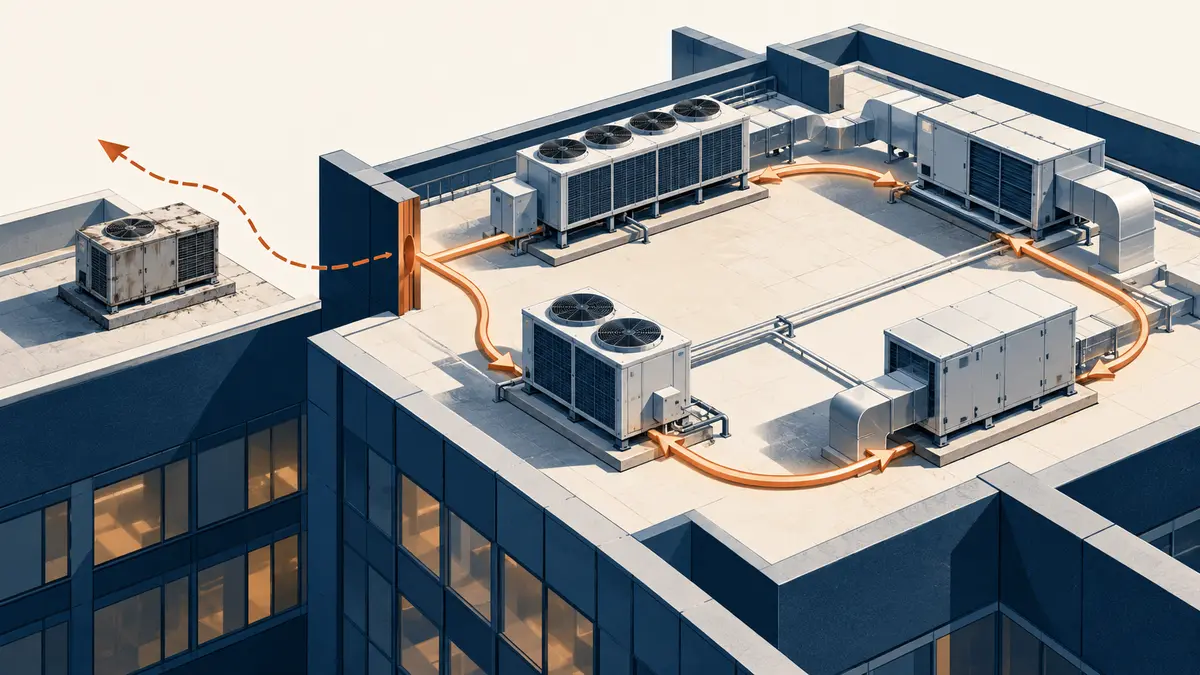
A busy callout diary can hide a weak service portfolio
The phones are active and urgent jobs keep arriving. Yet emergencies displace planned maintenance, estimators review unsuitable estates and prospects expect coverage the current rota cannot protect. This is a contract-selection problem: every agreement commits future technician time, skills, travel, parts and response performance.
My verdict: market the installed systems the operation can maintain reliably and profitably, then make fit visible before a full survey or proposal. The best recurring contract is not necessarily the largest site. It is one where scope, technical capability, response obligations, evidence and economics can survive delivery and renewal.
Unlike home-service lead generation or construction project acquisition, commercial HVAC growth depends on an installed estate, continuing obligations, specialist availability and renewal.
The Commercial HVAC Contract Fit & Capacity Gate
Run six checks before treating an enquiry, tender or portfolio conversation as qualified pipeline. The gate does not replace a technical survey, contract review or jurisdiction-specific compliance advice. It decides where those resources deserve to go.
Does the building fit?
Match property type, geography, access, stakeholders and buying process.
What must be maintained?
Clarify equipment, age, condition, controls, refrigerants and records.
Can the promise hold?
Test service windows, criticality, escalation and out-of-hours coverage.
Can technicians deliver?
Confirm skills, certification, supervision, parts and specialist partners.
Can value survive?
Model planned labour, travel, risk, exclusions, working capital and contribution.
Can trust compound?
Define service evidence, issue ownership, improvement work and renewal review.
Comfort Systems USA’s 2025 Form 10-K separates existing-building work, service projects, and service calls, maintenance and monitoring. It also identifies variables including labour availability, complexity, materials and subcontractors. This is one operator’s disclosure, not a benchmark; it confirms that fit and delivery economics belong in acquisition.
US EPA Section 608 rules also require specific service practices and records in defined circumstances. Requirements vary by equipment and jurisdiction, so marketing should promise only capabilities the operation can document.
The Search-to-Renewed-System Value Loop
The gate protects one opportunity. This loop makes acquisition accountable for the commercial and service outcome that follows.
Name service fit
Agree priority buildings, systems, geography and minimum economics.
Meet relevant demand
Use search, referrals, facility networks and procurement routes.
Apply the gate
Clarify estate, criticality, timing, decision and coverage before deep work.
Price the obligation
Document condition, access, history, planned work, risk and exclusions.
Prove the promise
Connect visits, findings, issues, response and improvement recommendations.
Return retained value
Compare service evidence, contribution, relationship health and renewal.
The US Department of Energy says effective operations and maintenance supports reliability, safety and energy efficiency. Connect the service plan to the owner’s risks and evidence, not a generic promise to “keep systems running.”
Acquisition should follow capacity. Targeted demand can strengthen utilisation when the right specialists have room; it can damage response and renewal when urgent work already displaces contract visits. Review whether to pause advertising when fully booked before increasing spend.
Make the commercial evidence chain visible
Build a contract-level record joining source, account, installed-system summary, response expectation, survey effort, price, award, delivery cost and renewal.
| Evidence stage | Owner question | Decision signal |
|---|---|---|
| Initial enquiry | Is this commercial service demand? | Building, geography, system and timing are identifiable |
| Fit review | Should technical time be invested? | Coverage, capability and decision path are plausible |
| Survey | Is the obligation understood? | Estate condition, access, history and exclusions are documented |
| Proposal | Can the contract contribute? | Price protects planned delivery, risk and response promise |
| Delivery | Did the operating assumptions hold? | Labour, travel, parts, issues and customer evidence reconcile |
| Renewal | Did the relationship retain value? | Service quality and contribution justify continuation or change |
If systems cannot calculate contribution reliably, start with agreed stages and a small reconciled cohort. Do not label every repair “contract pipeline” or optimise advertising toward unqualified form fills.
Choose the next move from the actual constraint
| What leadership sees | Verdict | Best next move | Avoid |
|---|---|---|---|
| Many leads; few commercial sites | Intent mismatch | Separate residential callouts from commercial contract demand | Reporting all enquiries as one pipeline |
| Suitable accounts; wrong systems | Capability mismatch | State system experience and qualification boundaries earlier | Promising coverage before technical review |
| Surveys high; proposals low | Qualification gap | Ask estate, timing, decision and response questions sooner | Surveying every interested facility |
| Proposals strong; awards weak | Proof or position gap | Review losses, decision criteria, evidence and incumbent advantage | Cutting price before diagnosing the loss |
| Contracts won; contribution weak | Scope or cost gap | Return delivery variance and reactive exposure to pricing | Calling every award a marketing success |
| Delivery sound; renewals weak | Account-value gap | Make service evidence, issues and improvement ownership visible | Waiting for expiry to discuss value |
If small sites consume disproportionate effort, consider a minimum project size. If results depend on one source, use the channel dependency framework.
A 90-day commercial service-contract demand test
Define fit and reconcile
Review recently won, lost and renewed accounts. Agree building, estate, geography, response, capability and contract economics.
Build one contract path
Create proof and a decision page for one buyer and service profile. Add qualification without making the first contact difficult.
Test and decide
Run one controlled demand route. Compare fit reviews, surveys, proposals and early commercial evidence.
Ninety days is a decision window, not an award promise. Decide whether to scale, repair, narrow or hold until capacity improves.
ThomPerformance connects commercial search demand, buyer decision pages, contract-stage measurement and AI-assisted customer insight. Review the case studies, evidence standards and operator-led approach.
Frequently asked questions
How can a commercial HVAC company get more service contracts?
Define the buildings, systems, geography and response promises the company can serve well. Build proof, capture relevant demand, qualify the installed estate before a deep survey, and return award, contribution and renewal evidence to marketing.
What makes a commercial HVAC service contract profitable?
Profitability depends on equipment condition, scope, visit frequency, technician skill, travel, parts exposure, response commitments and payment terms. A large agreement can still be weak when the estate is unknown or emergency obligations exceed capacity.
Should an HVAC company quote every maintenance enquiry?
No. Quote when the property, equipment, geography, access, decision process, response expectations and economics fit. Clarify gaps before committing survey time, and decline or reprice obligations the business cannot serve reliably.
Do Google Ads work for commercial HVAC companies?
They can capture active demand when commercial capability, service area, system experience and the next step are clear. They work poorly when residential callouts and commercial contracts share one path or every submission is valued equally.
How should commercial HVAC companies measure marketing return?
Track each source through fit, survey, qualified proposal, award, collected revenue, direct service cost and renewal. Enquiry volume diagnoses acquisition; retained contract contribution is the owner-level result.
Grow the service portfolio the operation can renew profitably
Start with the installed estate and response promise, make commercial capability easy to verify, qualify before survey effort grows and return delivered contribution and renewal evidence to the next acquisition decision. That is a stronger growth system than a busier callout diary.
Sources and evidence notes
- Comfort Systems USA 2025 Form 10-K — commercial customer mix, service activity and contract execution context.
- US Department of Energy: Operations and Maintenance in Federal Facilities — reliability, safety and efficiency context.
- DOE Better Buildings: Preventative Maintenance for Commercial HVAC Equipment — maintenance planning and equipment-life context.
- US EPA: Stationary Refrigeration Service Practice Requirements — technician practices for stationary air-conditioning equipment.
- US EPA: Recordkeeping and Reporting Requirements — selected technician and owner/operator record obligations.
Search-volume prioritisation is qualitative; no unverified volume is presented. Company filings and US public guidance illustrate material commercial and operating considerations. They are not universal benchmarks or legal advice. Requirements vary by equipment, contract and jurisdiction.