
What you receive from a B2B paid media audit
This service is for a founder or marketing lead who needs to know whether weak performance comes from the account, tracking, offer, lead quality, sales follow-up or unit economics. The diagnosis can cover Google Ads, Meta Ads and LinkedIn Ads, but the output is one commercial priority list rather than three disconnected platform checklists.
Spend, objectives, bidding signals, brand versus non-brand demand, audiences, offers and creative roles.
Primary events, duplicate or missing signals, lifecycle definitions and lead-to-opportunity evidence.
Allowable acquisition cost, maturity window, quality rates and the commercial threshold for each decision.
Priorities ranked by financial exposure, evidence confidence and time to correct, with owners and validation rules.
The free 48-hour diagnostic identifies whether a full audit is justified. Full scope and timing are confirmed only after the required access and evidence are reviewed; no fixed result or universal benchmark is promised.
For a CRM feedback implementation, use the HubSpot–Meta Conversions API authority guide. If sales rejects paid enquiries, start with the B2B lead-quality diagnosis.
Do not start the audit inside the ad platforms
A campaign can show a low cost per lead and still consume cash. It can also show an expensive lead while creating valuable opportunities. The difference sits outside the advertising interface: qualification rules, sales acceptance, opportunity value, win rate, margin and the delay between first contact and revenue.
My verdict is simple: the account is not healthy unless the business can explain what the platform is optimising for and how that action progresses toward revenue. The specialist should inspect settings. The owner should approve the commercial definitions, evidence standard and acceptable risk.
This matters because the platforms act on the signals they receive. Google distinguishes primary conversion actions used for bidding from secondary actions used mainly for observation. Meta recommends sending downstream lead outcomes from a CRM back through Conversions API so its system can learn what a successful lead looks like. These are not technical housekeeping details; they determine which prospects receive the next budget dollar. Google Ads conversion-goal guidance; Meta lead and CRM guidance.
The B2B Paid Media Waste Map
I use four evidence zones with three checks in each. Score every check Clear, Uncertain or Failed. The purpose is not to manufacture a percentage score. It is to find the first weak link that makes later optimisation unreliable.
| Zone and check | Owner question | Evidence to inspect | Commercial risk if missing |
|---|---|---|---|
| 1 · Outcome | What business result is paid media meant to create? | One defined qualified-lead, opportunity, customer or revenue outcome | The team optimises activity instead of growth |
| 2 · Economics | What can we afford to pay? | Deal value, gross margin, win rate, sales cost and allowable acquisition cost | A target can look efficient while destroying margin |
| 3 · Time | How long until results mature? | Lead-to-opportunity delay, sales cycle and conversion-lag view | Budget is cut or scaled before evidence is complete |
| 4 · Bidding signal | What action receives optimisation weight? | Campaign goal, primary action and exact event definition | The system finds easy actions rather than valuable buyers |
| 5 · Reconciliation | Do platform leads exist in the CRM? | Matched counts by date, source and unique lead ID | Duplicate or missing events distort every efficiency metric |
| 6 · Downstream feedback | Does sales quality return to marketing? | Qualified, rejected, opportunity and won outcomes by source | Cheap low-quality leads train future delivery |
| 7 · Demand role | Is the campaign creating or capturing demand? | Brand, non-brand, prospecting, remarketing and existing-customer split | Existing demand is mistaken for incremental growth |
| 8 · Market fit | Are we reaching buyers the business can serve? | Market, account, role, location, exclusions and accepted-lead patterns | Sales receives volume outside commercial fit |
| 9 · Offer journey | Does the page earn the next step? | Message continuity, proof, qualification, mobile usability and response path | Media pays to expose a weak buying experience |
| 10 · Creative learning | What have we learned about buyer motivation? | Distinct problems, claims, evidence types and recorded test decisions | More assets are produced without new learning |
| 11 · Sales response | Can the team convert the demand generated? | Response time, contact rate, rejection reasons and follow-up ownership | Marketing absorbs failure created after the form |
| 12 · Change control | Can we isolate what improved the result? | Change log, decision owner, evaluation window and reversal condition | Simultaneous edits destroy the evidence |
The sequence matters. If economics are undefined, a cost target has no business meaning. If the bidding signal is wrong, campaign refinement amplifies the wrong outcome. If CRM feedback is absent, the account can optimise lead volume while the sales team quietly rejects the result.
Ask for an evidence pack, not a list of opinions
A useful audit should show enough evidence for another responsible person to follow the reasoning. Ask the operator to provide:
Target outcome, contribution or margin logic, sales-cycle length and the acquisition ceiling.
Lead, qualified, opportunity and won counts by source using consistent dates and stage definitions.
Every primary conversion, its definition, source, counting rule and the campaigns using it.
Brand capture, non-brand capture, prospecting, remarketing, retention or market validation.
Creative, offer, audience and page tests with the decision—not a gallery of winning ads.
Expected commercial effect, implementation owner, evaluation date and reversal condition.
LinkedIn's current Revenue Attribution Report illustrates the intended direction: CRM connection enables reporting on pipeline amount, revenue won, opportunities and sales conversion metrics, while attribution settings still affect interpretation. The tool does not remove judgment; it makes the underlying business evidence available. LinkedIn Revenue Attribution Report guidance.
Evidence should also match the provider you are buying. Review the service model to see who owns diagnosis and delivery, compare the Meta versus LinkedIn decision matrix, inspect the case studies for traceable outcomes and limitations, and use the Thomas Ho profile to verify the operator behind the recommendation.
Use the specialist channel pages when the evidence points to platform-specific work: Google Ads management, Meta Ads management or LinkedIn Ads management.
If you need the working checks, use the free B2B Paid Ads Audit Checklist. For the commercial maths, use the Paid Ads Pipeline Calculator. Both are support tools; the owner decision still depends on the evidence quality.
Decide what to protect, repair, reduce or stop
| Decision | Use it when | What happens next | What would reverse it |
|---|---|---|---|
| Protect | Commercial economics and downstream quality are credible | Preserve delivery while testing one controlled improvement | Quality or marginal economics weaken after a complete decision window |
| Repair | The opportunity is credible but one evidence link is broken | Hold expansion; fix measurement, offer, page or sales feedback first | The repaired cohort still fails the economic threshold |
| Reduce | Some spend has a role, but exposure exceeds the confidence available | Concentrate budget on defensible segments and preserve a smaller learning cell | New evidence restores confidence or confirms failure |
| Stop | The market, offer or economics fail despite reliable measurement | Remove the unsupported investment and document why | A material change creates a genuinely different commercial test |
Do not use one weak week as a decision window when the sales cycle is longer. Google notes that conversion delay can temporarily make cost per acquisition look inflated and return on ad spend look depressed. Match the review window to how the business actually converts, and record pricing, promotion, capacity or sales-process changes that could move the result. Google Ads conversion-lag guidance.
Likewise, do not let a blended account result hide the source of demand. The PMax brand-cannibalisation teardown shows how an efficient campaign can inherit existing demand. The article on low CPL without sales explains why qualification and opportunity progression can reverse a channel verdict.
A 30-day audit-to-decision plan
Define truth
Agree the commercial outcome, stage definitions, allowable economics and decision window.
Reconcile evidence
Match platform actions to CRM records and map what every campaign is optimising toward.
Prioritise repairs
Fix the earliest failed link before changing downstream settings or adding new spend.
Run one controlled test
Record the hypothesis, owner, commercial metric, evaluation date and reversal rule.
A paid media audit should end with fewer priorities, not a longer fault list. Rank issues by financial exposure × evidence confidence × time to correct. Give the first three actions an owner and a date. Everything else remains documented but does not compete for attention.
If the audit reveals a wider growth constraint rather than an account problem, review why business growth has stalled. If the question is whether to invest in advertising at all, start with paid advertising readiness.
Sources and evidence notes
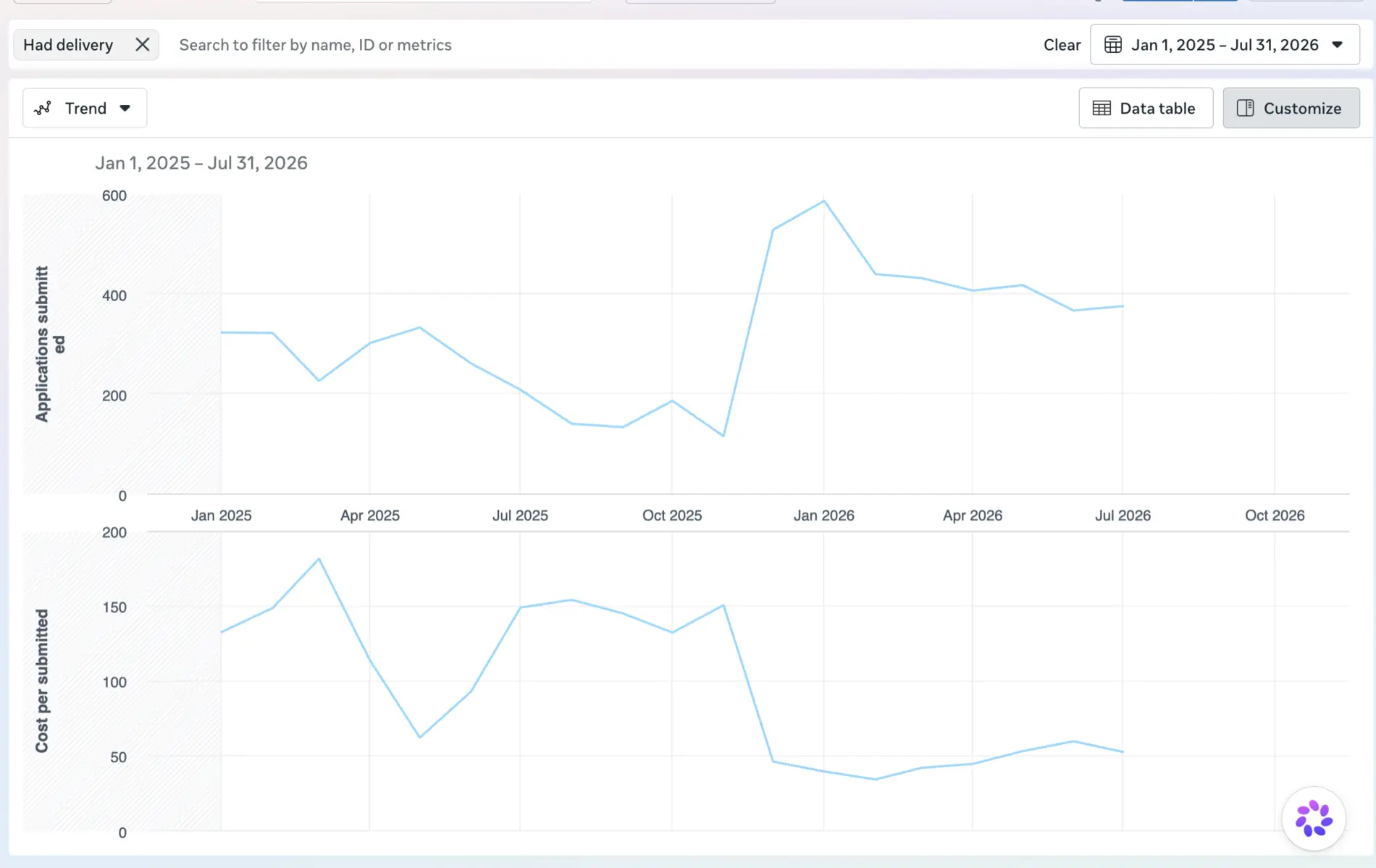
Platform documentation and links were checked on 29 August 2026. The B2B Paid Media Waste Map, four-way decision matrix and 30-day plan are original ThomPerformance analysis. The dashboard is real account evidence but does not independently prove sales quality or revenue. No search volume, universal benchmark or performance guarantee is claimed.
Frequently asked questions
What should a B2B paid media audit include?
It should connect spend to a defined commercial outcome, test the economics, verify conversion and CRM evidence, separate captured demand from new demand, inspect the offer and creative system, and show how sales feedback changes budget decisions. A settings checklist without pipeline evidence is incomplete.
How often should a business audit paid advertising?
Run a full audit before a material budget increase, after a tracking or CRM change, when lead quality declines, when the sales model changes, or at least quarterly for an active programme. Weekly reviews should monitor agreed signals without repeatedly rebuilding the account.
Does a high cost per lead mean advertising is failing?
Not by itself. A more expensive lead can create a lower cost per qualified opportunity if it progresses through sales at a higher rate. Compare lead cost with qualification, opportunity creation, win rate, deal value and margin before reducing spend.
Should we pause campaigns when tracking is unreliable?
Not automatically. Hold expansion first, quantify how much bidding and reporting depend on the broken signal, and protect campaigns with credible commercial evidence. Pause only where the risk of continued waste outweighs the value of preserving demand and learning.
Can an owner use this audit without opening an ad account?
Yes. The owner-level job is to ask for the evidence behind each decision: CRM reconciliation, funnel rates, demand split, creative learning record and a prioritised action plan. A specialist can perform the platform checks, but the business should approve the commercial definitions and risk thresholds.
Audit the investment, not only the account
The strongest audit connects commercial truth, clean measurement, qualified demand and operating discipline. It tells an owner why a result is credible, which risk deserves attention first and what evidence would justify the next budget decision.