
Start with Meta when the buyer problem is shared across a broad reachable market and creative can do the filtering. Choose LinkedIn when employer, function, seniority or named-account precision materially changes qualification. If the budget cannot generate enough qualified outcomes on both, fund one channel and use the CRM to earn the second test.
Use this resource when
Decision matrix
| Decision factor | Meta Ads | LinkedIn Ads |
|---|---|---|
| Structural advantage | Scale, visual discovery and creative-led relevance | Role, seniority, function, company and industry precision |
| Best demand state | The market needs the problem or offer made relevant | The buyer profile is known and reachable by professional attributes |
| Best offer | Proof-led demo, webinar, calculator or problem-specific asset | Role-specific report, ABM offer, event or high-value demo |
| Main qualification risk | Broad messages attract curiosity outside the ICP | Precise targeting cannot rescue a generic or low-value offer |
| Creative requirement | More distinct hooks, proof formats and iterations | Fewer assets can work, but the business context must be sharper |
| Budget pressure | Usually more delivery volume, but quality must be returned from CRM | Higher distribution cost can slow learning in narrow cells |
| Primary decision metric | Cost per accepted SQL by creative angle | Cost per accepted SQL by audience and account segment |
| Choose first when | Creative can filter a broad market more efficiently | Firmographic precision changes who sales will accept |
Cost per qualified opportunity is the decision
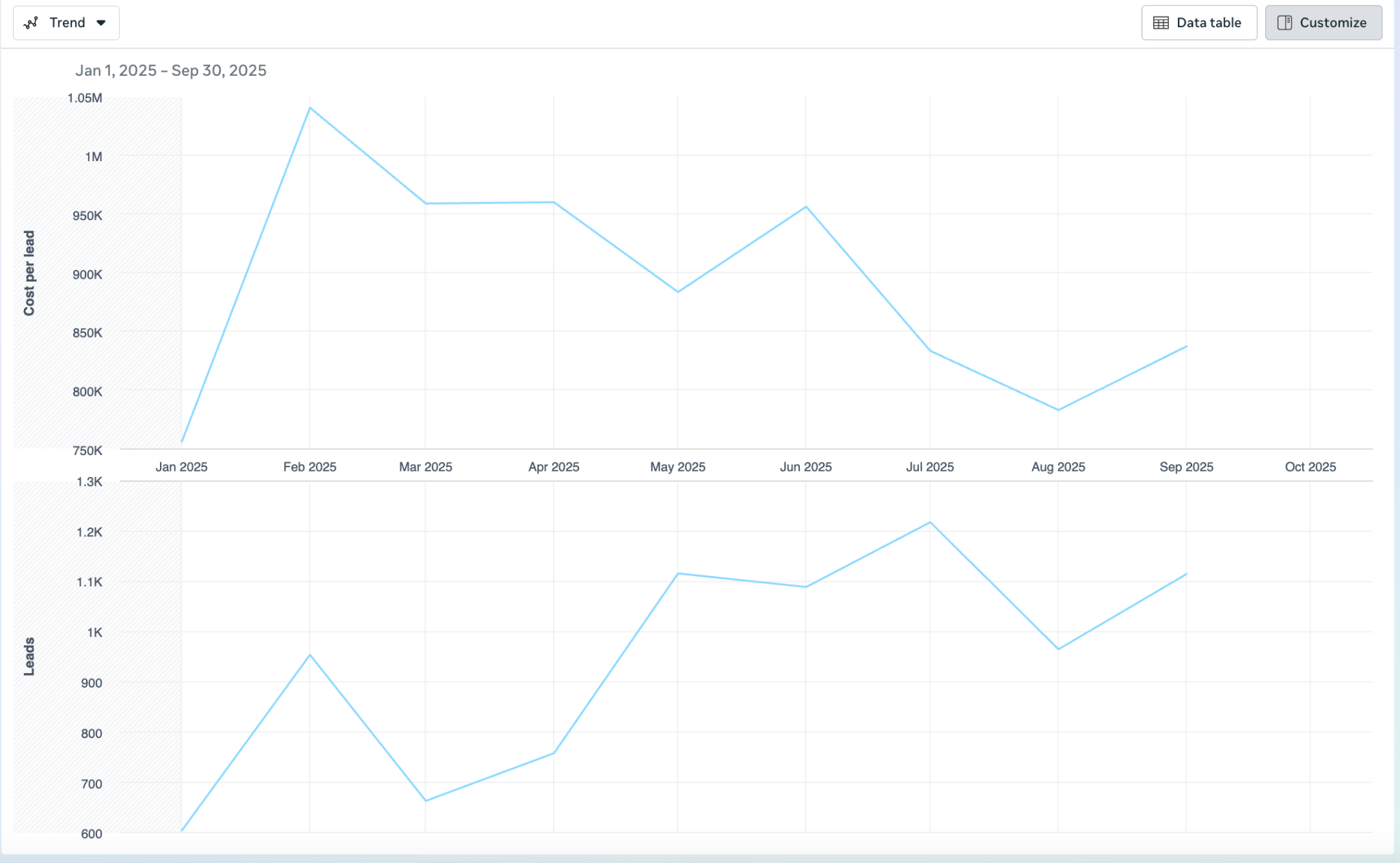
A cheaper Meta form fill can create more sales work and less pipeline. A more expensive LinkedIn lead can still be the better investment when qualification and opportunity rates are materially higher. Reconcile both channels to the same CRM stages before comparing them.
Use the ICP precision test
Ask whether the ad must know the prospect's employer, function, seniority or named account before it can be relevant. If yes, LinkedIn has a structural advantage. If the pain is shared across a broad market, Meta can let message, proof and creative behaviour perform more of the filtering.
- Choose LinkedIn when the eligible buyer list is narrow and explicit
- Choose Meta when the problem is widespread but the audience needs education
- Do not confuse targeting precision with purchase intent
Use the creative and offer test
Meta normally demands more creative variation because the ad must interrupt and make the problem relevant. LinkedIn can carry more business context, but professional targeting does not compensate for a weak offer. Keep the commercial claim consistent while adapting the execution to each feed.
Use the budget and learning test
Concentrate a limited budget on the channel most capable of answering the next commercial question. Splitting early creates two underfed systems and too few accepted SQLs to compare.
Run a fair channel comparison
Keep the offer, landing destination, qualification questions and CRM stages consistent. Let each platform use its native strength: creative breadth on Meta and controlled firmographic cells on LinkedIn. Compare accepted SQL rate, opportunity creation, sales-cycle quality and pipeline per $1,000 after a complete decision window.
Practical questions
Questions that change the decision
Is LinkedIn always better for enterprise B2B?
No. It is better when account or role precision materially changes qualification. Meta can still create demand, demonstrate proof and reach broad buying groups efficiently.
Is Meta cheaper than LinkedIn for B2B leads?
Meta often produces lower-cost form fills, but that does not establish lower customer-acquisition cost. Compare accepted SQLs, opportunities, pipeline and revenue using the same CRM definitions.
Can I use the same creative on both platforms?
Keep the core commercial claim, but adapt the execution. LinkedIn can carry more role and company context; Meta normally needs a faster visual and message hook plus more variation.
Should a small B2B budget be split across both?
Usually not at the start. Choose the channel that can answer the largest uncertainty, establish CRM-quality evidence and add the second channel only when it can receive a meaningful test budget.
Which channel should receive retargeting budget?
Use the channel with sufficient reachable audience and a defined incremental job. Small B2B audiences can saturate quickly on either platform, so exclude customers and recent converters where appropriate.
Sources and platform documentation
Platform features change. These links point to the primary documentation used for the implementation details above.