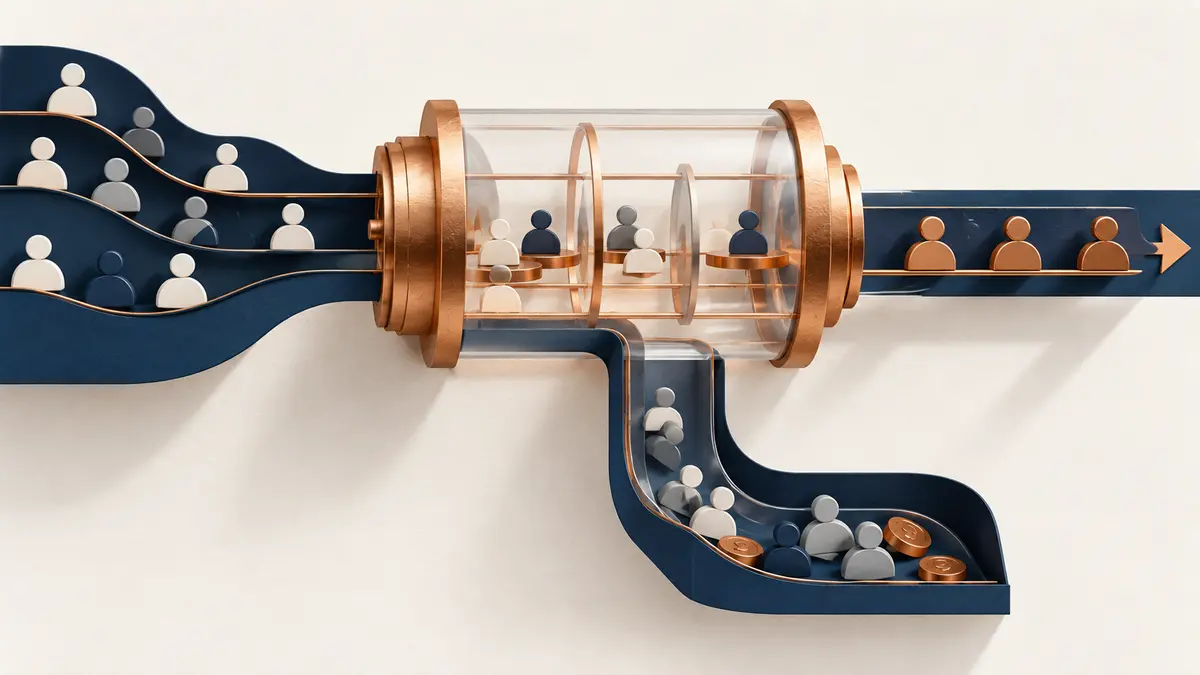
A free trial should remove proof risk, not remove every buying commitment
My verdict is: use a free trial when the customer can experience the core value largely by themselves and each extra trial is inexpensive to serve. Do not use one merely because competitors do, sign-ups look easy to grow or “free” sounds persuasive.
The job is to let a suitable buyer verify value before paying. When proof needs consulting, migration, procurement or weeks of work, free access may create a support queue instead.
This differs from a subscription model, a money-back guarantee and free consultations, where senior time is the scarce product.
The Free Trial Commercial Readiness Gate
Pass all six checks before opening the offer to free demand. A failed check points to the next experiment or alternative.
Can the buyer prove the outcome?
Expose the real job customers buy, not a tour that withholds decisive value.
Can value arrive in the window?
Measure time to a meaningful result, including setup and dependencies.
Can the business serve free use?
Include infrastructure, onboarding, support, misuse and expert time.
Can suitable demand be identified?
Preserve signals that separate probable customers from curiosity.
Is the paid decision unmistakable?
State the price, timing, renewal and cancellation before sign-up.
Can contribution be reconciled?
Connect activation, conversion, early retention, cost and contribution.
If users cannot reach value without manual rescue, improve onboarding or choose a guided path. If the product has high variable cost, put a usage boundary around the trial. If the paid outcome cannot be reconciled, repair conversion tracking before buying traffic for the offer.
Choose the proof model that matches the buying risk
| Customer and delivery reality | Best starting model | What it proves | Main risk |
|---|---|---|---|
| Fast, self-service value; low serving cost | No-card free trial | Activation and product fit | Many inactive or low-intent starts |
| Repeat-use subscription; clear consumer terms | Card-on-file trial | Use plus willingness to continue | Billing surprise, distrust and cancellations |
| Configuration, expert time or several stakeholders | Paid pilot | Value, collaboration and willingness to pay | Over-customising the pilot |
| Sensitive data or difficult implementation | Guided demo or sandbox | Capability and process fit | Showing features without proving the customer outcome |
| Value is immediate after purchase and delivery is reliable | Clear guarantee | Confidence after payment | Refund exposure if eligibility is vague |
Card collection changes who starts, how billing works and how much trust the transition requires. Stripe documents no-card trials, opt-in renewal, reminder events and end behaviours such as cancel or pause. These are options, not evidence that one model fits every business.
The Trial-to-Paid Value Evidence Loop
A free trial is not one conversion rate. It is a sequence that shows where value, fit and economics are gained or lost.
Define suitable demand
Name the customer, use case, prerequisite and disqualifiers.
Record the cohort
Keep source, promise, model and start date attached.
Complete the value action
Track real use—not a login, tour click or account creation.
Reach a meaningful result
Confirm the customer experienced the outcome being sold.
Make payment explicit
Present price, scope, timing and cancellation clearly.
Read retained contribution
Subtract trial and acquisition costs from paid contribution.
The FTC described free-to-pay plans as negative-option marketing in March 2026 and noted that US federal coverage varies by practice. UK subscription rules announced on 2 April 2026 are expected in spring 2027, with clearer information, trial-end reminders and simpler cancellation. Requirements vary; obtain qualified advice.
Reconcile trial economics by cohort
| 60-day cohort check | Illustrative value | Owner interpretation |
|---|---|---|
| Suitable trial starts | 1,000 | Qualified cohort, not total form fills |
| Reached meaningful activation | 350 | 650 starts never proved the value |
| Became paying customers | 70 | 7% of suitable starts; comparison still needed |
| Trial serving and support cost | $18,000 | $18 across every suitable start |
| 90-day contribution from paid cohort | $21,000 | Before acquisition cost and overhead |
| Decision | Narrow and retest | Improve activation or qualification before scaling traffic |
The figures are synthetic, not a benchmark. They show why 1,000 starts can look successful while producing only $3,000 before acquisition cost and overhead.
Compare the cohort with the previous sales path or a paid pilot. More starts are not enough if contribution, retention or sales efficiency weakens.
A 60-day free-trial decision test
Define value and cost
Name the suitable customer, activation event, meaningful outcome, service boundary, legal review and full trial cost.
Run a bounded cohort
Use one offer, one access model and controlled acquisition. Capture source and trial start without changing every variable.
Repair the value path
Review where suitable users fail to activate or realise value. Fix product and onboarding friction before buying more starts.
Reconcile the decision
Compare paid conversion, early retention, support cost and contribution with the previous path; proceed, narrow, price or stop.
Proceed when suitable users reach value, paid contribution covers trial and acquisition cost, and the transition earns trust. Narrow when one segment or use case works. Use a paid pilot when proof consumes expert capacity. Stop when the offer mainly creates unused accounts, support demand or accidental billing.
Use landing-page work to clarify the promise and qualification, review the case studies, and apply the evidence standards before presenting a trial conversion chart as proof of profitable growth.
Evidence boundary: Sources and current search results were checked on 5 October 2026. Priority is qualitative; no search volume, universal conversion rate or legal conclusion is claimed. The gate, loop, matrix and reconciliation are ThomPerformance practitioner tools. Illustrative figures are synthetic and are not client results, forecasts or benchmarks.
Frequently asked questions
What makes a free trial commercially worthwhile?
Suitable buyers reach meaningful value inside the window, paid-customer contribution covers trial costs and results are measured by cohort. More sign-ups alone are not evidence of a good trial.
Should a free trial require a payment card?
A card may reduce low-intent starts but increases the need for clear price, conversion, renewal and cancellation terms. Choose by buyer trust, operating model and applicable law—not conversion folklore.
Is a paid pilot better than a free trial for B2B services?
Often. Use a paid pilot when proof needs senior time, customer data, configuration, several stakeholders or bespoke work. It protects capacity and tests willingness to pay.
What should a business measure during a free-trial test?
Measure suitable starts, activation, time-to-value, serving cost, paid conversion, early retention and contribution by cohort. Compare these with the previous buying path.
Make the trial earn its place in the growth system
Use a trial when it turns uncertainty into experienced value at a controlled cost. Measure activation, make payment explicit and reconcile contribution by cohort. Otherwise choose a paid or guided proof.
Discuss a free-trial growth diagnostic