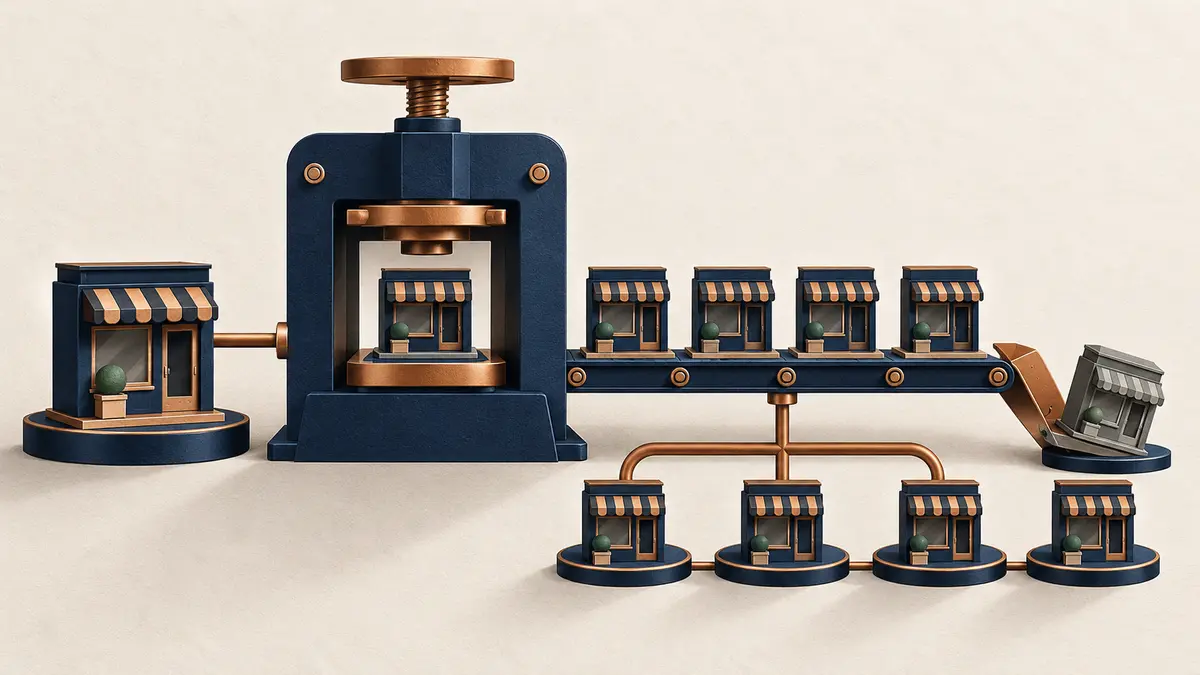
Franchising transfers a system, not just a brand
A successful first business can make franchising look like the obvious next move. Other people provide much of the capital, new territories open and the brand collects fees. That description leaves out the central commercial question: can an independent operator reproduce the customer outcome, earn a worthwhile return and receive enough support for the network to remain healthy?
My verdict is direct: do not franchise while the founder is still the operating system. Strong sales at one site are not proof that demand travels, decisions transfer or a second operator can preserve quality. A franchise network magnifies whatever is already true. Clear economics and repeatable delivery can compound. Weak margins, undocumented exceptions and inconsistent customer acquisition can compound faster.
This decision is different from opening a second company-owned location. A second site retains more ownership and operating control. A franchise introduces independent operators, a continuing commercial relationship and market-specific disclosure and conduct duties. It is also different from simply testing a new market: you are asking another party to invest in a system you must be able to explain and support.
The Franchise Replication Readiness Gate
Score these six conditions before paying to package or promote a franchise offer. A weakness in any one can make faster recruitment commercially dangerous.
Does the unit win repeatedly?
Prove demand across normal seasons and customer cohorts, not one launch, founder network or unusually strong location.
Can both parties earn?
Model franchisee cash return and franchisor contribution after every realistic opening, operating and support cost.
Can decisions be taught?
Document the customer journey, daily operation, quality thresholds, exception handling and management rhythm.
Can the promise stay consistent?
Define what operators may adapt, what must remain standard and how quality is observed and corrected.
Can the network be served?
Fund recruitment, onboarding, training, field support, technology, marketing governance and improvement before scale.
Is it worth buying?
Give a capable operator a credible reason to choose the system after investment, fees, effort, risk and alternatives.
Franchising is also regulated. The US Federal Trade Commission Franchise Rule requires franchisors to give prospective franchisees a disclosure document containing 23 specified information items. In Australia, the Franchising Code of Conduct is mandatory; the current code was introduced on 1 April 2025, with some provisions applying from 1 November 2025. It addresses disclosure, agreements, conduct and the franchisor–franchisee relationship. Obtain specialist legal and financial advice in every market. This article is commercial guidance, not legal advice.
Test the network economics from both sides
Owners often model the royalty stream but understate the cost of creating and supporting it. Build two views. The franchisee view includes setup, working capital, local payroll, occupancy, customer acquisition, required purchases, fees and owner compensation. The franchisor view includes candidate acquisition, sales, disclosure, onboarding, training, technology, field support, quality assurance, dispute capacity and central leadership.
| Illustrative annual item | Per unit | Owner interpretation |
|---|---|---|
| Franchisee sales | $600,000 | Only valuable if local cost and working-capital assumptions are realistic |
| Royalty at an assumed 6% | $36,000 | An example assumption, not a recommended rate |
| Allocated support cost | $22,000 | Training, field support, systems and quality work still consume resources |
| Contribution before central overhead | $14,000 | Ten mature units would contribute $140,000 before central overhead |
| New central capability | $180,000 total | The network can remain cash-negative while early units are recruited and supported |
The example deliberately shows the gap between attractive-looking royalties and the cash needed to operate a responsible franchisor. Replace every assumption with verified costs and downside cases. Do not present illustrative economics as an earnings claim to candidates.
A written business plan should expose the assumptions, resources and financial needs behind growth. Australian Government business-planning guidance recommends reviewing market, finances, goals and the people and resources needed to achieve them. Use that discipline before treating franchise fees as funding for a system that does not yet exist.
The Unit-to-Network Evidence Loop
The readiness gate is the go/no-go screen. This loop turns the idea into evidence while keeping the cost of being wrong contained.
Find what truly drives the unit
Separate brand, location, founder relationships, offer, local talent, process and demand-source effects.
Make the system visible
Define decisions, roles, standards, data, economics and escalation routes—not just task checklists.
Train another operator
Let a capable non-founder run the model with agreed support and record every rescue or ambiguity.
Try a less forgiving context
Test normal demand, labour and cost conditions rather than choosing only a near-perfect pilot.
Operate the franchisor
Measure onboarding, field support, response time, quality variance and the cost of keeping the promise.
Read both businesses
Return customer outcomes, franchisee health and franchisor contribution to the expansion decision.
Use structured market and customer research to test whether demand exists beyond the original unit. Interviews, lost enquiries, competitor alternatives and small market tests reveal more than national market size. If the business still depends on one person to close or rescue delivery, first address founder-dependent growth.
Choose the expansion route that matches the evidence
| Evidence pattern | Verdict | Best next move | Avoid |
|---|---|---|---|
| Strong unit, founder still essential | Not ready | Transfer sales, delivery and exception decisions to a non-founder operator | Selling territories around a personality |
| Repeatable delivery, weak unit margin | Repair economics | Improve price, mix, labour or process before adding fees and support layers | Using franchise fees to hide weak trading |
| Healthy model, demand is highly local | Test portability | Run a bounded market test and compare customer acquisition and retention | Assuming brand awareness travels |
| Strong model, no support capability | Build the franchisor | Design onboarding, field support, governance, systems and realistic capacity | Recruiting faster than support |
| Strong system, one adjacent market | Consider a controlled pilot | Use one carefully selected operator or another company unit to expose transfer gaps | Launching multiple territories at once |
| Healthy operators and support economics | Earn measured scale | Add territories at the rate the evidence and support team can absorb | Optimising for franchise leads alone |
Franchising is one option, not the default reward for a successful unit. Licensing, company-owned expansion, partnerships or staying focused may preserve more value. If leadership and delivery are already constrained, apply the capacity growth framework. If the offer is too broad to transfer cleanly, use the Specialisation Growth Gate.
A 120-day franchise-readiness test
Reconcile one unit
Verify demand sources, margins, working capital, founder interventions, customer outcomes and normal seasonal variation.
Expose the operating system
Document decisions, standards, training, local flexibility, data access, escalation and the support the brand must provide.
Run a transfer simulation
Put a non-founder operator through the system, log every ambiguity and cost the real support workload.
Test demand and downside
Research one representative market, model slower sales and higher costs, then obtain specialist legal and financial review.
Continue only when the operator, customer and franchisor can all succeed under reasonable downside assumptions. Repair when a solvable process, economics or capacity constraint is visible. Choose another route when the value depends on control, founder judgement or a location advantage that cannot transfer.
When the franchise proposition is ready, Google Ads can capture active operator or local-customer demand, conversion tracking can connect source to approved candidates and opened units, and practical AI-assisted analysis can organise anonymised questions and support themes. The tools should serve the operating evidence—not substitute for it.
Frequently asked questions
How do I know if my business is ready to franchise?
A business is closer to franchise-ready when a proven unit produces dependable customer demand and attractive economics without constant founder intervention; its operating system can be taught and audited; the brand can be protected; and the franchisor can fund recruitment, training, field support, compliance and network improvement before royalty income becomes dependable.
Is franchising cheaper than opening a second location?
It can require less company capital per new unit, but it creates different costs and obligations. The franchisor must build documentation, legal disclosure, recruitment, training, quality assurance, technology and continuing support. Compare the complete network economics and control trade-offs—not merely the cash needed to open one company-owned site.
How profitable should a business be before franchising?
There is no universal margin threshold. The relevant question is whether a representative franchisee can earn an attractive return after local operating costs, fees and required investment while the franchisor retains enough recurring contribution to provide the promised support. Model downside cases and obtain market-specific financial and legal advice.
Can I franchise a founder-led business?
Not safely while customers, staff decisions or service quality still depend on the founder. First document how demand is generated, how work is delivered, which decisions are local and which are controlled, and how exceptions are handled. Prove that another capable operator can reproduce the customer outcome with normal support.
Should I generate franchisee leads with paid advertising?
Only after the franchise proposition, target operator, territories, disclosures, qualification process and support capacity are ready. Paid media can create conversations; it cannot make a weak unit model investable. Measure approved candidates, completed due diligence, opened units and healthy operator cohorts—not lead volume alone.
Build evidence before you sell expansion
A franchise-ready business is not merely popular. It has a transferable promise, two-sided economics, a teachable operating system and enough leadership capacity to support independent operators through normal difficulty. The safest next move is usually a bounded transfer test—not a recruitment campaign.
Review paid digital marketing and AI growth services, the case-study library, my evidence standards and practitioner background. If you need an owner-level diagnosis of demand, economics and expansion evidence, start a business-growth conversation.