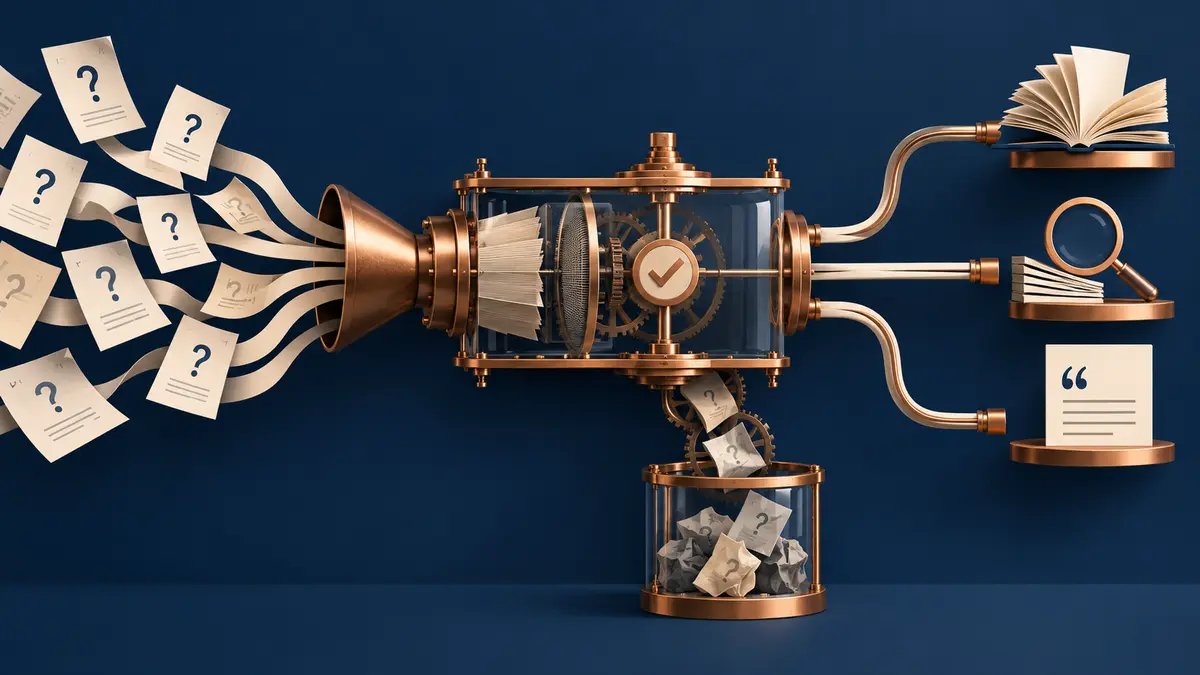
The business case starts with repeated friction, not content volume
A prospect asks whether your service works in their market. A customer emails about the same setup problem for the fourth time. Sales answers one way, support answers another and the website says nothing. The cost is larger than one reply: slower decisions, inconsistent expectations and useful business knowledge that remains invisible.
A public knowledge base is a maintained library of answers available without a login. It may cover eligibility, product use, delivery, billing, service boundaries, troubleshooting and common buying decisions. It is not the same as an internal wiki, a generic blog or a pile of AI-generated frequently asked questions.
My verdict is direct: build the smallest knowledge base that removes repeated customer friction and can stay accurate. Start with questions that affect revenue, support capacity, trust or customer success. Give every answer a named owner, evidence source and review trigger. If the business cannot maintain ten useful pages, publishing one hundred creates a liability rather than an asset.
This intent is narrower than the guide to making a business discoverable in Google and AI search. That article diagnoses the full visibility system. This one decides whether repeated customer knowledge deserves a public, searchable operating system.
The Public Knowledge Base Investment Gate
Use six checks before buying software, migrating documentation or assigning a content target.
Does the question recur?
Use support tickets, sales calls, internal search, reviews and lost-deal notes—not brainstorming alone.
Does the answer change action?
Prioritise questions that affect fit, purchase, onboarding, successful use, retention or avoidable contact.
Can one truthful answer exist?
Separate stable guidance from customer-specific advice, confidential terms and regulated decisions.
Who keeps it correct?
Name the subject owner, approval route, review trigger and retirement decision before publication.
Can customers and crawlers find it?
Use public URLs, descriptive titles, internal links, valid canonicals and an indexable sitemap.
What should improve?
Choose a baseline across repeat contacts, assisted journeys, qualified outcomes and discovery—not page views alone.
The Knowledge-Centered Service practices guide describes knowledge as something captured from real requests and improved through use. That supports a demand-led approach: solve the repeated question, publish the verified answer and let reuse expose what needs correction.
Google likewise recommends helpful, reliable, people-first content rather than pages created mainly to attract search traffic. The investment gate therefore rejects a keyword-led article factory even when the software makes publication easy.
Reconcile service capacity, buyer progress and discovery
A knowledge base can create several forms of value, but they must not be counted as if every view prevented a support contact or caused a sale. Some customers read an answer and still need help. Some prospects would have converted without it. Some search visits have no commercial fit.
| Monthly signal | Before pilot | After pilot | What the business may infer |
|---|---|---|---|
| Repeated contacts on five topics | 120 | 82 | 38 fewer contacts observed; causation still needs checking |
| Knowledge-assisted suitable enquiries | Not tracked | 19 | The answer appeared in a measurable buyer path |
| Search impressions for answer pages | 0 | 3,400 | Discovery increased; impressions are not customers |
| Pages overdue for review | 0 | 2 | Maintenance capacity is already becoming a constraint |
The owner should value the combined pattern, not multiply 38 by a guessed support cost and call the result proven savings. Check whether volume, product issues, staffing, seasonality or routing changed during the same period.
Google says its generative search features use publicly accessible, crawlable content and that established search fundamentals still apply. Its current AI optimisation guidance does not promise inclusion. OpenAI similarly says OAI-SearchBot is used to surface websites in ChatGPT search and must be allowed for content to appear in search answers. Access creates eligibility, not authority or commercial value.
The Question-to-Verified-Answer Operating Loop
The investment gate decides whether to build. This six-stage loop prevents the library becoming stale content inventory.
Record the customer language
Preserve the words, situation, stage and consequence behind support, sales and search questions.
Find material repetition
Group variations by the decision or problem they represent, not by a convenient keyword list.
Approve the business truth
Confirm scope, evidence, exceptions, owner and effective date with the responsible team.
Make one answer usable
Lead with the verdict, show steps or trade-offs, link the right service and expose limitations.
Put the answer in the journey
Connect it from product, service, sales, support and related resource pages where the question occurs.
Let use trigger maintenance
Review when policy, pricing, product, search demand or customer feedback materially changes.
The loop also prevents content overlap. A concise support answer can link to a deeper decision guide without duplicating it. Customer proof belongs in an approved case study; recurring sentiment can support a review strategy; original data needs the safeguards in the research-publishing guide.
Measure Google discovery through the Search Console performance report. Google also documents a generative AI performance report, rolled out worldwide on 31 August 2026, for eligible properties with enough activity. Combine that evidence with on-site use, support categories, assisted journeys and CRM outcomes.
Match the knowledge model to the business problem
| Situation | Verdict | Owner action | Avoid |
|---|---|---|---|
| Support repeatedly answers stable questions | Build a focused public base | Start with the highest-volume, highest-consequence topics | Uploading every internal procedure |
| Prospects need proof and trade-offs before contacting sales | Publish decision resources | Use direct verdicts, evidence, limitations and a relevant next step | Turning sales collateral into thin FAQs |
| Answers vary by customer, regulation or contract | Publish boundaries, not personalised advice | Explain what can be answered publicly and route exceptions safely | Presenting general information as a binding decision |
| Content exists but customers cannot find it | Repair access and routing first | Improve titles, navigation, internal links, search and index eligibility | Creating more articles before fixing discovery |
| No team owns accuracy | Delay expansion | Assign owners and review triggers to a small pilot | Using AI to scale an unmaintained library |
| The main problem is private internal consistency | Use an internal knowledge system | Separate employee procedures and customer data from public answers | Publishing confidential operational detail |
If visibility is the broader problem, review how to measure AI search visibility. If traffic already exists but revenue does not, use the traffic-to-revenue diagnosis. ThomPerformance's AI growth systems and broader paid-growth services connect customer knowledge to acquisition, conversion and measurement.
A 60-day public knowledge-base pilot
Baseline and select
Count repeated questions, find five to ten material topics, define private boundaries and assign subject owners.
Verify and publish
Create direct answers with evidence, exceptions, useful next steps, public URLs, metadata and contextual internal links.
Route and reconcile
Place answers in customer journeys, compare repeat contact and qualified outcomes, review discovery and repair weak pages.
Expand when customers use the answers, teams reuse them and maintenance remains controlled. Repair when pages attract the wrong audience or fail to resolve the question. Restrict information that should not be public. Stop scaling when ownership and accuracy cannot keep pace.
Before commissioning a large library, review ThomPerformance's approved case evidence, evidence standards and operator-led approach. Those pages show the standard every public answer should meet.
Frequently asked questions
What is a public knowledge base?
A public knowledge base is an organised collection of verified answers that customers, prospects and search systems can access without signing in. It may cover product use, service scope, eligibility, billing, delivery, troubleshooting or buying questions. It is different from an internal wiki containing private procedures or customer data.
Can a knowledge base improve SEO and AI search visibility?
It can create useful, crawlable answers for specific questions, but publication alone does not guarantee rankings or citations. Pages still need accurate information, clear ownership, internal links, index eligibility and genuine demand. Google and OpenAI both require public access for their search systems to consider the content.
How many knowledge-base articles should a business publish first?
Start with the smallest set that addresses repeated, material questions—often five to ten rather than dozens. Select questions using support conversations, sales calls, internal search, lost-deal reasons and Search Console. Expand only when a new article owns a distinct problem and someone is responsible for maintaining it.
Should pricing and service limitations appear in the knowledge base?
Yes when they help buyers make a better decision and the information can be kept accurate. Explain ranges, exclusions, prerequisites and exceptions in plain language. Do not publish confidential commercial terms, customer-specific arrangements or claims that the business cannot substantiate.
How should a business measure whether its knowledge base is working?
Track answer use, repeated-contact volume, assisted enquiries, qualified conversions, search impressions, cited pages and content freshness. Compare the whole customer journey rather than claiming every page view as a saved ticket or sale. Agree a baseline, owner and review period before launch.
The owner decision
Publish fewer answers. Keep them true, findable and useful.
A public knowledge base is worthwhile when repeated customer questions have commercial or service consequences and the business can maintain one trusted answer. Begin with a controlled pilot, connect each page to a real journey and measure the whole outcome. Discovery value should follow usefulness—not replace it.
Discuss your knowledge and discovery system