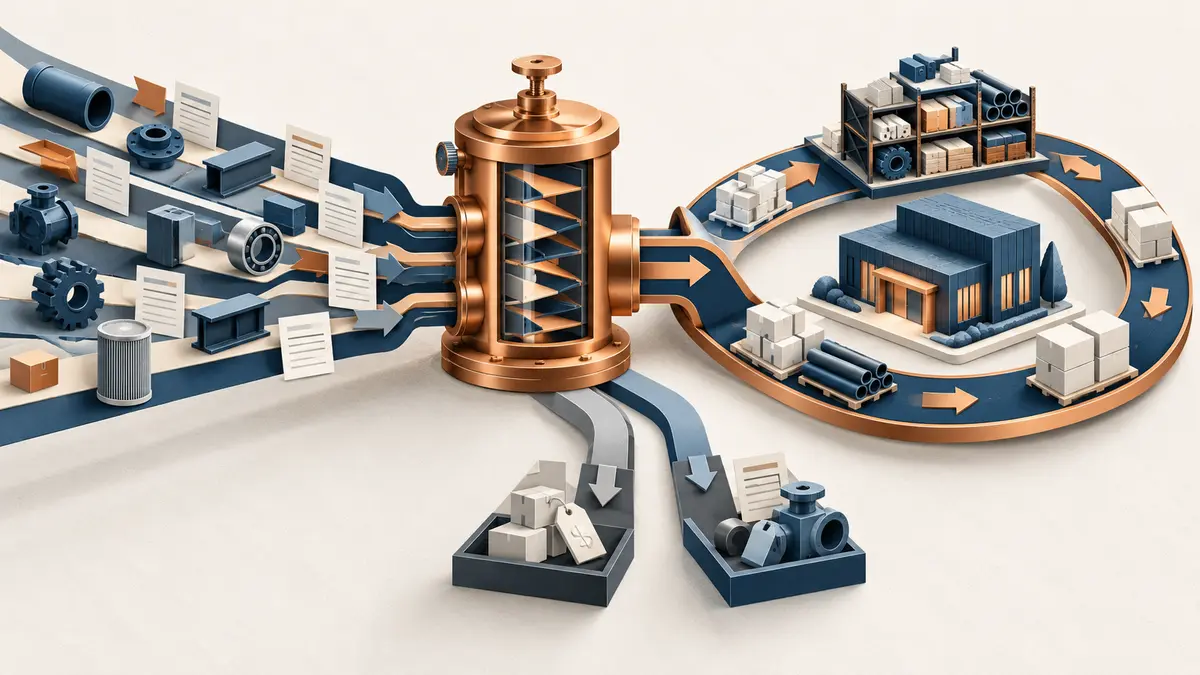
Grow the account—not the enquiry count
An industrial distributor can buy more traffic and still create worse economics. A small urgent order may need technical help, a manual quote, split fulfilment, expedited freight and credit administration. The sale appears in revenue while the cost of winning and serving it disappears across teams.
That is why the growth question is not “How do we generate more industrial leads?” It is which customer sites can we serve repeatedly, at an acceptable contribution, with an offer that is difficult to replace?
Fastenal's 2025 annual report illustrates the trade-off at scale: growth in larger contract customers increased volume but those accounts generally carried lower gross margins. The same filing treats customer-site spend, digital adoption, product visibility, fulfilment efficiency and differentiated service as connected growth drivers. The lesson for an independent distributor is not to copy a multinational network. It is to judge acquisition alongside customer mix, service design and retained value.
Start with the segment. Use the customer-segment decision guide to choose a narrow application, geography and buying situation. Then make your availability, technical capability, delivery boundary and trade-account terms clear enough that suitable buyers can self-select.
The Trade Account Fit & Service Cost Gate
Score a proposed segment before increasing marketing spend. A strong market is not merely large; it fits what you can stock, support and fulfil reliably.
Do you solve a specific operating job?
Name the equipment, facility, process or compliance need—not a broad industry label.
Can your range cover the job?
Confirm brands, substitutes, certifications, bundles and technical knowledge.
Does demand suit your network?
Check order size, frequency, location, urgency, seasonality and lead-time tolerance.
What remains after fulfilment?
Include discount, picking, freight, returns, rebates, payment cost and sales time.
Can you support the promise?
Model quoting, specification, kitting, site delivery, onboarding and exception handling.
Is the account risk acceptable?
Set credit, deposit, minimum order and approval rules before demand reaches sales.
Can the relationship deepen?
Look for replenishment, adjacent categories, multiple sites and embedded workflow value.
A segment with low product margin may still be valuable when orders are predictable and service cost is controlled. A high-margin line may be unattractive when demand is sporadic, returns are complex or every enquiry requires senior technical attention. Use the gate to expose the whole operating job.
The Search-to-Retained-Trade-Account Evidence Loop
Marketing, sales, inventory and finance need one evidence trail. Without it, advertising learns to create forms while the business absorbs the commercial consequences.
Capture the buying job
Separate exact-product searches, application problems, supplier replacement and urgent availability.
Route to a truthful answer
Use category, application and location pages that match range, support and service area.
Expose operational reality
Show availability status, lead-time conditions, delivery options, substitutions and account rules.
Protect sales capacity
Record application, quantities, frequency, location, timing, account potential and decision stage.
Reconcile the first order
Connect quote, stock allocation, freight, support effort, returns and collected contribution.
Measure account value
Track reorder, category expansion, service cost, payment behaviour and retained contribution.
This loop changes what advertising is allowed to optimise. Google Ads now distinguishes a qualified lead from a converted lead and supports offline outcomes from a CRM or internal system. That means your campaign can learn from accepted trade accounts or completed commercial stages rather than treating every form equally.
Implement that feedback through conversion tracking, but keep the owner-level rule simple: the platform receives the stage and value the business trusts. It does not invent your definition of a good account.
Fix the constraint that is destroying account value
| Business symptom | Likely constraint | Owner decision | Evidence to watch |
|---|---|---|---|
| Many enquiries, few worthwhile quotes | Broad targeting or weak self-qualification | Narrow the segment and state account rules earlier | Qualified-account rate and sales time per accepted lead |
| Orders arrive for unavailable items | Marketing is detached from stock and lead time | Limit promotion, expose availability states and provide approved substitutes | Stock-backed quote rate, backorders and lost orders |
| Revenue grows while margin weakens | Discount, freight or service cost is hidden | Set segment-specific minimums, freight rules and service boundaries | Contribution after fulfilment by account and order pattern |
| Quotes are slow or inconsistent | Sales capacity or product data is the bottleneck | Standardise common configurations and route complex work deliberately | Quote response time, win rate and exception volume |
| First orders do not repeat | Poor fit, weak onboarding or no replenishment path | Analyse first-order cohorts and design the next useful action | Second-order rate, days to reorder and category expansion |
| Good accounts are found but cannot scale | Fulfilment, credit or account-service capacity | Fix the operating constraint before adding more demand | On-time fulfilment, receivables, support load and retained contribution |
If the business has a demand shortage, Google Ads can capture buyers already searching for products, applications and supply alternatives. If suitable buyers reach the site but do not progress, use conversion-focused landing pages and the demand-versus-conversion diagnosis before raising budget.
If traffic is healthy but sales are not, review the traffic-without-sales guide. If quotes stall after acceptance, use the qualified-lead follow-up framework. Your constraint determines the intervention.
Run a 90-day profitable-account growth test
Choose one account thesis
Define application, geography, order pattern, buying trigger, range fit, service boundary and financial rules.
Build the evidence path
Align pages, offers, stock language, form fields, call handling, CRM stages and account-value reporting.
Test controlled demand
Use a bounded search campaign and existing channels. Review queries, qualification, quotes, orders and fulfilment together.
Decide from retained value
Scale, refine or stop based on suitable accounts, contribution, operational load and early repeat evidence.
Do not set a universal target from an online benchmark. Use your gross margin, freight structure, sales capacity, payment terms and reorder cycle. Search opportunity here is prioritised qualitatively; no unverified search volume is used.
The National Association of Wholesaler-Distributors describes modern distributor marketing as a connected customer journey using product content, real-time inventory, segmentation, replenishment and data-enabled services. That supports the direction, but your experiment should remain small enough to reconcile manually before automation makes the learning harder to inspect.
Practitioner note: I would not scale a distributor campaign while successful conversion still means “submitted a quote request.” First agree what sales accepts, which first-order economics are viable and what early behaviour signals a retained account. Then give the advertising system that better evidence.
Review related case evidence, how ThomPerformance combines paid media and decision systems through AI Growth, and the experience behind the recommendations on the About page.
Frequently asked questions
What is industrial distributor marketing?
Industrial distributor marketing attracts and develops business buyers for stocked products, technical support and supply services. Unlike manufacturer marketing, it must connect demand with product availability, order economics, service effort and repeat purchasing—not just promote a product brand or collect enquiries.
Should an industrial distributor advertise individual products or solutions?
Use product-led demand when buyers know the exact item, specification or category. Use application and problem-led pages when the decision depends on compatibility, availability, substitution, technical advice or supply continuity. Both routes should lead to a truthful stock, lead-time and service promise.
How do we avoid paying for price shoppers?
You cannot eliminate comparison shopping, but you can qualify earlier. Make service area, trade-account criteria, minimum order rules, delivery options, supported applications and response expectations clear. Then send qualified-account and converted-sale outcomes back to the advertising system instead of optimizing for every form submission.
What should an industrial distributor measure beyond leads?
Track qualified trade accounts, quote-to-order rate, first-order contribution, repeat order rate, average account spend, service cost, returns, freight recovery, payment behaviour and retained contribution. The useful unit is the account or customer site over time, not the cheapest enquiry.
How long should a distributor growth test run?
Run long enough to observe qualification, a first commercial outcome and an early repeat signal where the buying cycle allows. A 90-day test is a useful operating window, but reorder cycles, tender timing and product lead times may require a longer evidence period.
Acquire the account your operation is built to retain
A profitable industrial distributor growth system starts with fit, not reach. Choose the customer site and buying job you can serve well, expose the truth about range and fulfilment, qualify before sales time is consumed, and reconnect marketing to contribution and repeat behaviour. That is how more demand becomes a stronger account base instead of a more expensive queue.
Sources and evidence notes
- Fastenal 2025 Annual Report (Form 10-K) — customer and product mix, contract-account margin context, digital footprint, customer-site spend, fulfilment and competitive factors.
- Fastenal: How We Win — supply continuity, local service, embedded solutions and long-term customer relationships.
- Google Ads Help: Qualified leads and converted leads — connecting advertising with deeper offline lead and sale stages.
- Google Ads Help: Enhanced conversions for leads — current first-party-data and offline-conversion guidance.
- National Association of Wholesaler-Distributors: Distributor marketing strategy — digital catalogue, inventory, segmentation, replenishment and customer-journey context.
Editorial note: Sources and current search results were reviewed on 10 October 2026. Search opportunity is prioritised qualitatively; no unverified search volume, client result, margin benchmark or conversion rate is used. The Trade Account Fit & Service Cost Gate, Search-to-Retained-Trade-Account Evidence Loop, constraint matrix and 90-day test are original ThomPerformance analysis.