
A real result can still tell an incomplete story
A case study is useful when it reduces the uncertainty of a buying decision. It should help an owner understand the problem solved, the work performed, the outcome observed and whether the experience is relevant to the business in front of them.
The common failure is often a genuine number stripped of context. A 10x return may use platform-attributed value rather than received revenue. A 200% increase may begin from a small base. A low lead cost may hide low sales acceptance.
My verdict is straightforward: trust a case study in proportion to how much of its evidence chain you can inspect. A polished story is not a problem. A polished story that prevents reasonable scrutiny is.
This is also consistent with current advertising guidance. The UK CAP advises that objective claims should have documentary substantiation, and that testimonials alone are unlikely to substantiate objective claims. The U.S. FTC says an endorsement cannot make a representation that would be deceptive or unsupported if the advertiser made it directly. CAP substantiation guidance, 12 March 2026; FTC advertising guidance.
The Case Study Credibility Chain
I use six connected checks when I publish proof and when I assess another provider. None is a universal legal test. Together, they make a commercial claim much easier to judge.
What changed?
Name the observed outcome precisely: revenue, enrolments, qualified opportunities, purchases or another defined result.
Compared with what?
Show the baseline, budget, customer count or other denominator that gives the headline number meaning.
When did it happen?
State the date range and whether seasonality, promotions or conversion delay affect the comparison.
What recorded it?
Explain the metric, platform, CRM, commerce system or finance record behind the claim.
Who did what?
Separate the provider's direct work from the client team, product, sales process, market and other contributors.
What is not proved?
State attribution boundaries, confidentiality, missing data and why the result is not a forecast or guarantee.
Start with the business outcome, not the platform trophy
Clicks, impressions and cost per lead can diagnose part of a marketing system. They are not automatically evidence of business growth. For lead generation, look for movement from enquiry to qualified opportunity, decision and revenue. For ecommerce, ask whether recorded sales produced acceptable contribution after product, discount, fulfilment, returns and advertising costs.
If a provider lacks commercial records, state that limitation. The guide on knowing whether marketing is working explains how marketing, sales and finance evidence should connect.
Interrogate the denominator and time period
A percentage without its base is hard to evaluate. “Revenue increased 100%” can mean a move from £1,000 to £2,000 or £1 million to £2 million. The scale, investment and operational difficulty are different. The same is true of a return figure without spend, a cost reduction without volume, or a lead increase without sales acceptance.
The period matters because buying cycles and attribution are not instantaneous. Google Analytics applies attribution models to assign credit across customer touchpoints, which means a channel report is an allocation of credit under a defined model—not a direct observation of sole causation. Google Analytics attribution guidance.
Separate contribution from causation
Marketing works inside a business system. Product availability, pricing, brand demand, sales follow-up, promotions, conversion work and market conditions can all move the result. A credible operator explains what they changed and what else was happening. “I managed the account and rebuilt measurement” is a supportable scope statement. “I alone created all recorded revenue” usually requires evidence a platform screenshot cannot provide.
This is how I apply the ThomPerformance evidence policy: figures are reproduced in context, currencies and unlike conversion actions are not blended, client identity may be withheld, and past performance is never presented as a guarantee.
A worked example: what one dashboard proves
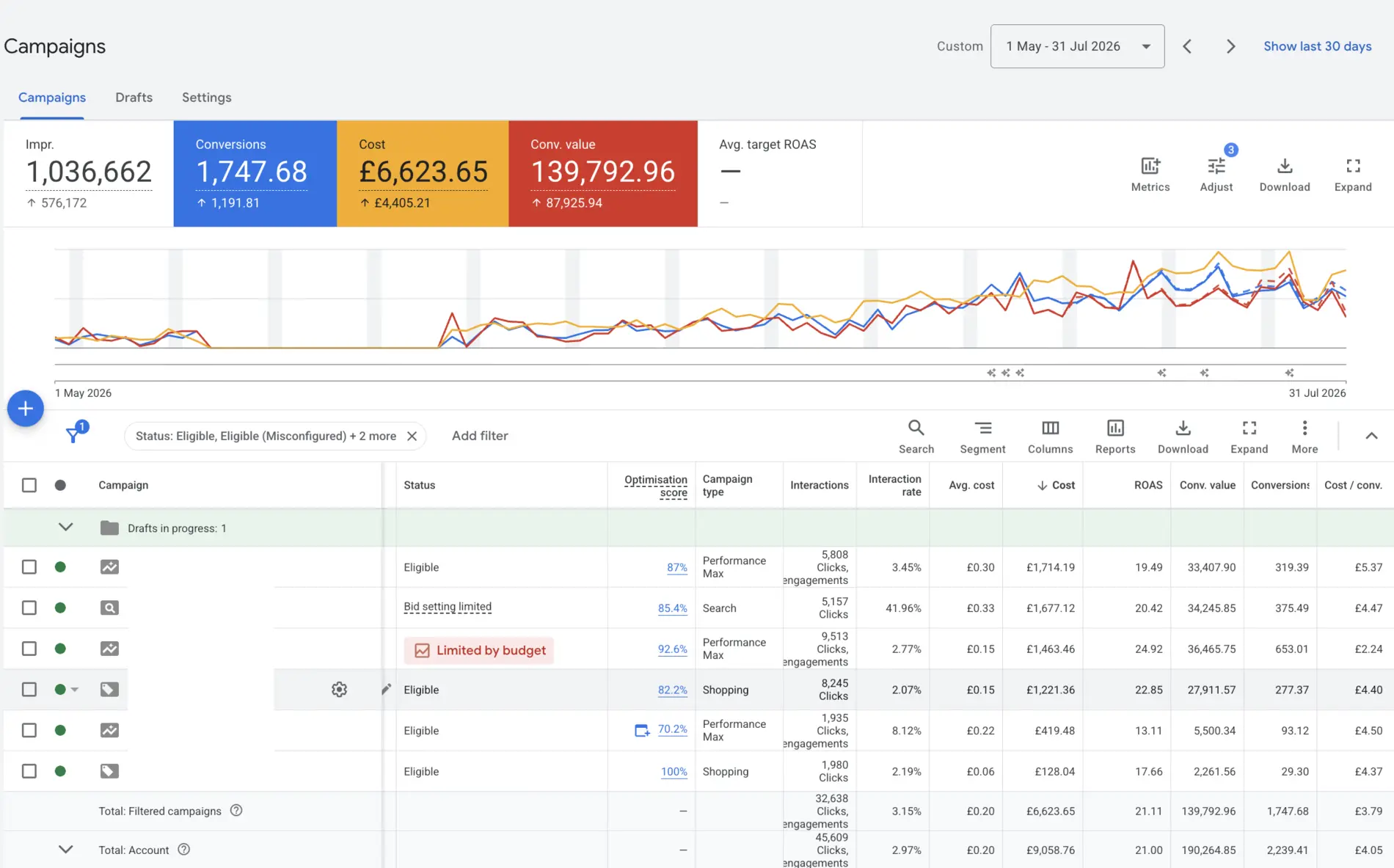
The source dashboard records £6,623.65 cost, £139,792.96 conversion value and 21.11 platform-reported ROAS for the selected period.
The screenshot supports a specific statement: Google Ads recorded those figures in that period. The spend denominator, platform and metric are visible, making it stronger than a cropped “21.11x” headline.
It does not prove that advertising caused every sale, that conversion value equals profitable revenue, that the period is typical, or that another business will reproduce the result. Those boundaries are part of the evidence.
For comparison, the documented education case on the case studies page reports 4,210 leads and 135 enrolments in October. The downstream enrolment count changes the interpretation because it moves beyond form fills. It still belongs to that client context and should not become a universal benchmark.
Australia's competition regulator makes the wider principle clear: advertising claims should be accurate, based on reasonable grounds and supported by evidence, and important limitations should not be omitted. ACCC guidance, checked 15 August 2026.
Ask these questions before you trust the case
Compare model, market, sales cycle, margins, maturity and operational capacity—not just industry labels.
Find the deepest verified outcome and identify where reporting stops.
Ask which platform or business system recorded it and how the metric was defined.
Distinguish direct execution, strategic direction, wider team work and client-controlled decisions.
Look for multiple comparable periods, a full sales cycle or an honest reason why only one window is shown.
A credible answer names prerequisites and conditions rather than promising the same headline.
When a client cannot be named, ask for redacted evidence and the missing context. Confidentiality is legitimate; unqualified vagueness is not proof.
Also review the operator behind the claim. The About page should make experience and direct responsibility clear, while the service model should show who will actually do the work after the sale.
Turn the evidence gap into a buying decision
| What you see | What it may prove | What is still missing | Owner decision |
|---|---|---|---|
| Headline result with no dates or base | A claim was selected for promotion | Scale, period, denominator and relevance | Do not use it to shortlist alone |
| Platform screenshot with spend and value | Recorded account state for that platform and period | Profit, incrementality, wider contributors and repeatability | Ask for commercial reconciliation |
| Lead result connected to CRM stages | Movement from response to sales qualification | Win rate, revenue, margin and sales-cycle maturity | Assess the deepest verified stage |
| Context, source, scope and limitations | The provider understands evidence boundaries | Whether the same method fits your constraints | Advance to a diagnostic conversation |
A credible case study does not need to prove universal success. It needs to help you make a better next decision. If the evidence is relevant and inspectable, use it to form sharper questions about your own economics, measurement and constraints. If it is only a trophy number, keep it outside the investment model.
Sources and evidence notes
Sources and live evidence were checked on 15 August 2026. The Case Study Credibility Chain, buyer questions and decision matrix are original ThomPerformance analysis. Search priority is qualitative; no search volume, universal benchmark or guarantee is claimed. Regulatory links are general information, not legal advice.
Frequently asked questions
What should a credible marketing case study include?
It should name the business problem, relevant context, provider contribution, time period, metric definition, source, commercial outcome and material limitations. The reader should be able to distinguish what was observed from what the provider believes caused it.
Is a dashboard screenshot enough proof?
No. A genuine screenshot can verify what one platform recorded for a selected account and period. It cannot, by itself, prove that the provider caused the whole result, that the platform value equals banked revenue, that customers were profitable or that another business should expect the same outcome.
Can an anonymised case study still be credible?
Yes, when confidentiality is explained and the remaining evidence is specific enough to inspect: market, channel, period, metric definition, scope, source and limitations. Anonymity becomes a problem when it removes every detail needed to judge relevance or verify the claim internally.
Should I reject a case study that does not name the client?
Not automatically. Some clients cannot be named. Ask whether the provider can explain the context, show suitably redacted source evidence and separate direct responsibility from wider team or client contributions. A named logo is not a substitute for a clear evidence chain.
What is the biggest red flag in a marketing case study?
A large percentage or return figure with no starting point, denominator, date range, metric definition or limitation. The number may be real, but the buyer cannot tell whether it reflects incremental growth, attributed platform value, a short promotion, a changed budget or a result typical of the work.
Buy the evidence chain, not the trophy number
A credible marketing case study connects a defined result to its denominator, period, source, commercial meaning, practitioner contribution and limitations. That does not remove every uncertainty. It gives the buyer enough context to ask better questions and judge whether the experience is relevant.
Which part of the evidence chain is missing from the case studies you are comparing?