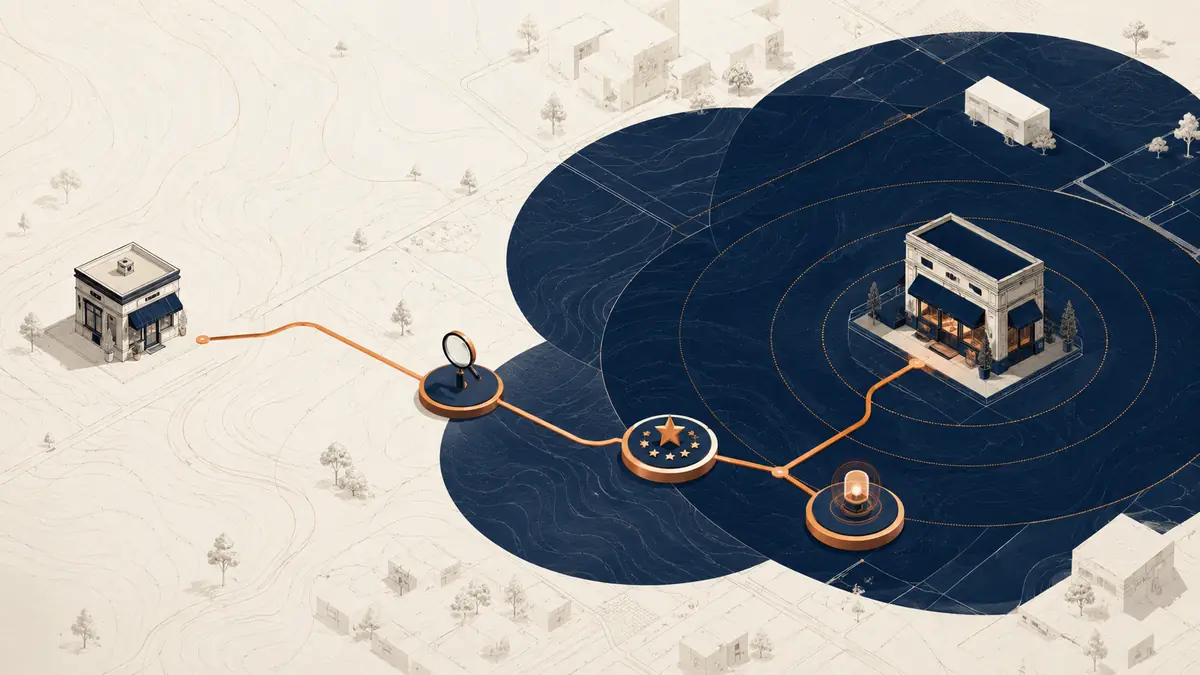
Do not mistake one search from one location for a market diagnosis
An owner searches for the main service from the office, cannot see the business in the map results and concludes that local search is broken. A team member repeats the search from home and sees a different set of businesses. Both observations can be true.
Google says local results are mainly based on relevance, distance and prominence. Distance means the searcher’s location is part of the result. A manual search is therefore a useful clue, not a reliable market-wide report.
My verdict is to separate three problems. Access failure means the business is not eligible, verified or available as expected. Discovery failure means it appears for the brand but not for suitable service-and-location searches. Conversion failure means people find it but do not call, book, visit or become suitable customers.
This article is narrower than the broader guide to business discoverability across Google and AI search. It is for a customer-facing location or service-area business deciding why nearby demand cannot reliably find or choose it.
Run the Local Visibility Diagnosis before funding more traffic
Start with the symptom you can verify. The fix changes according to where the business disappears.
Check eligibility, ownership, verification, restriction, duplication and whether the public information represents the real business.
The business identity exists, but service relevance, location evidence or prominence is too weak for non-brand discovery.
Reviews, proof, information, offer clarity, availability or the route to action may be losing the decision.
The search intent, service area, promise, landing page or qualification path attracts the wrong demand.
Google’s eligibility guidance says a Business Profile generally requires in-person contact with customers during stated hours, with defined exceptions. An online-only business cannot repair ineligibility by adding more local keywords. A genuine service-area business should represent its real operating model and follow the applicable profile rules instead of creating virtual or duplicate locations.
If the profile is suspended or disabled, Google says it will not show to other users until the issue is resolved. Treat that as an access problem. Do not let an agency disguise it as a vague need for more content, citations or links.
The six-stage Local Findability Chain
I use six connected gates to turn local discovery into a commercial system. A later gate cannot compensate for a broken earlier one.
Be a real, compliant business
Confirm the profile represents an eligible operation, is controlled by the business and is not blocked by a restriction or duplicate.
Match the customer’s need
Describe the actual category, services and customer problem consistently. Do not add locations or services the business cannot fulfil.
Make coverage understandable
Align the profile, contact details, location or service area, opening information and relevant website pages around the real operating footprint.
Give customers reasons to choose
Use genuine reviews, specific service evidence, useful photos, clear policies and credible local proof. Avoid manufactured ratings or borrowed claims.
Remove the enquiry break
Make calling, booking, visiting or requesting a suitable service easy from the profile and the landing page, especially on mobile.
Connect interactions to customers
Return service type, location, lead quality, booking outcome and revenue to the next visibility and investment decision.
Google recommends complete and accurate Business Profile information. Its LocalBusiness structured-data guidance also explains how a website can describe business details such as hours and departments. Structured data can help Google understand the page; it is not a ranking switch and does not guarantee a special result.
Reviews belong in the trust gate, not as a purchased ranking tactic. Google says reviews can help a business stand out and that review count and score can contribute to local ranking. In the United States, the FTC’s Consumer Reviews and Testimonials Rule has prohibited several fake and deceptive review practices since 21 October 2024. Ask for honest feedback, never a guaranteed positive rating.
Choose the next investment from the observed break
| Observed evidence | Likely constraint | Owner decision |
|---|---|---|
| The exact business name produces no normal profile result | Eligibility, verification, ownership, restriction or duplication | Resolve access and policy status before buying ranking work |
| The brand appears, but important services do not | Weak query relevance or incomplete service evidence | Clarify the real category, priority services and supporting pages around commercial demand |
| Visibility changes sharply by neighbourhood | Distance and genuine operating coverage | Test the actual service footprint; do not create false locations to manufacture proximity |
| Views rise, but calls and bookings remain weak | Trust, offer, availability or action-path friction | Improve proof and the mobile enquiry route before chasing more impressions |
| Calls rise, but unsuitable enquiries dominate | Intent, promise, service-area or qualification mismatch | Narrow the audience and make fit criteria visible before increasing reach |
The matrix is a management aid, not proof of causation. Search results vary by location, device, history and competitive context. Compare several relevant queries and places, then connect the pattern to profile performance, Search Console, website behaviour and sales evidence.
Google Business Profile performance can report calls, directions, bookings and website clicks. Google also warns that these measures describe profile interactions rather than every view or business outcome. A call click is not a qualified customer. Add booking, CRM or sales-stage evidence wherever the buying process allows.
If the website earns traffic but not customers, use the Traffic-to-Revenue Diagnostic. For a home-service business receiving too many low-value jobs, the Profitable Job Demand Loop helps align geography, job fit and capacity.
A 60-day local discovery reset
Confirm access
Document profile ownership, eligibility, verification, restrictions, duplicates and the real customer-facing locations or service areas.
Align the story
Reconcile the business name, category, services, hours, contact details and website location evidence. Remove claims the operation cannot support.
Strengthen choice
Improve useful service proof, genuine review collection, mobile actions and the landing-page path for the highest-value local intent.
Judge the chain
Compare relevant visibility, profile interactions, website actions and qualified outcomes. Continue, repair or narrow from the first stalled gate.
Sixty days is a governance window, not a ranking promise. A suspended profile, new location, competitive market or slow buying cycle may require different timing. The useful outcome is a documented baseline, a repaired first constraint and a decision rule for the next investment.
Do not start with a city-page factory. Create a location or service page only when it represents a real place, customer need, delivery capability and next action. Scaled pages that merely swap place names add little decision value and can create a confusing or misleading site.
Review AI and organic discovery services, case-study evidence, the evidence standards and Thomas’s operator model before choosing support. The conversion route is a business-growth diagnostic, not a promise to rank first.
Sources and evidence notes
Sources and search results were checked on 1 September 2026. Search prioritisation is qualitative; no unverified search volume, universal local-ranking timeline or proprietary performance result is claimed. The Local Visibility Diagnosis, Local Findability Chain, decision matrix and 60-day reset are original ThomPerformance analysis. No synthetic performance data is used.
- Google Business Profile: Tips to improve local ranking
- Google Business Profile: Business eligibility and ownership guidelines
- Google Business Profile: Find your business and resolve visibility problems
- Google Search Central: LocalBusiness structured data
- Google Business Profile: Performance and interaction measures
- Google Business Profile: Tips to get more reviews
- US Federal Trade Commission: Consumer Reviews and Testimonials Rule Q&A
Frequently asked questions
Why is my business not showing in local Google searches?
First determine whether the business is absent everywhere, missing only for non-brand searches, or appearing outside the area where you tested. Common causes include an ineligible, unverified or restricted Business Profile; incomplete or inaccurate business information; weak match to the customer’s query; limited local prominence; or a website that does not clearly support the location, service and business identity.
Can a business pay Google for a better local ranking?
No. Google states that there is no way to request or pay for a better local ranking. Advertising can buy separate paid visibility, but it does not purchase a stronger organic local position. Treat paid local demand and earned local discovery as different investments with one shared view of suitable enquiries and customers.
How long does it take to improve local search visibility?
There is no universal deadline. Eligibility or verification problems may need to be resolved before the business can appear normally. Profile, website and reputation changes then need time to be processed and tested across relevant locations and queries. Set staged checks for access, relevant visibility, customer action and qualified commercial outcomes rather than accepting a ranking guarantee.
Do reviews help a business appear in local search?
Google says review count and score can contribute to local ranking, and reviews can help a business stand out to customers. Ask genuine customers for honest feedback without requiring a positive rating, buying reviews or suppressing criticism. The FTC’s Consumer Reviews and Testimonials Rule prohibits several forms of fake and deceptive review conduct in the United States.
What should an owner measure from local search?
Measure visibility for relevant services and locations, Business Profile calls, directions, bookings and website clicks, plus website enquiries and the later quality or revenue of those outcomes. Google notes that profile interactions are useful platform measures, but owners still need CRM, booking or sales evidence to distinguish activity from suitable customers.
Repair the first missing link, then measure the customer
Local search is not one listing and one ranking. It is a chain from eligibility and relevance to location evidence, trust, action and commercial feedback. Find the first broken gate, repair it honestly and judge the investment by suitable customer outcomes—not by a screenshot from one postcode.
Which stage is currently least visible: access, non-brand discovery, customer choice or qualified revenue?