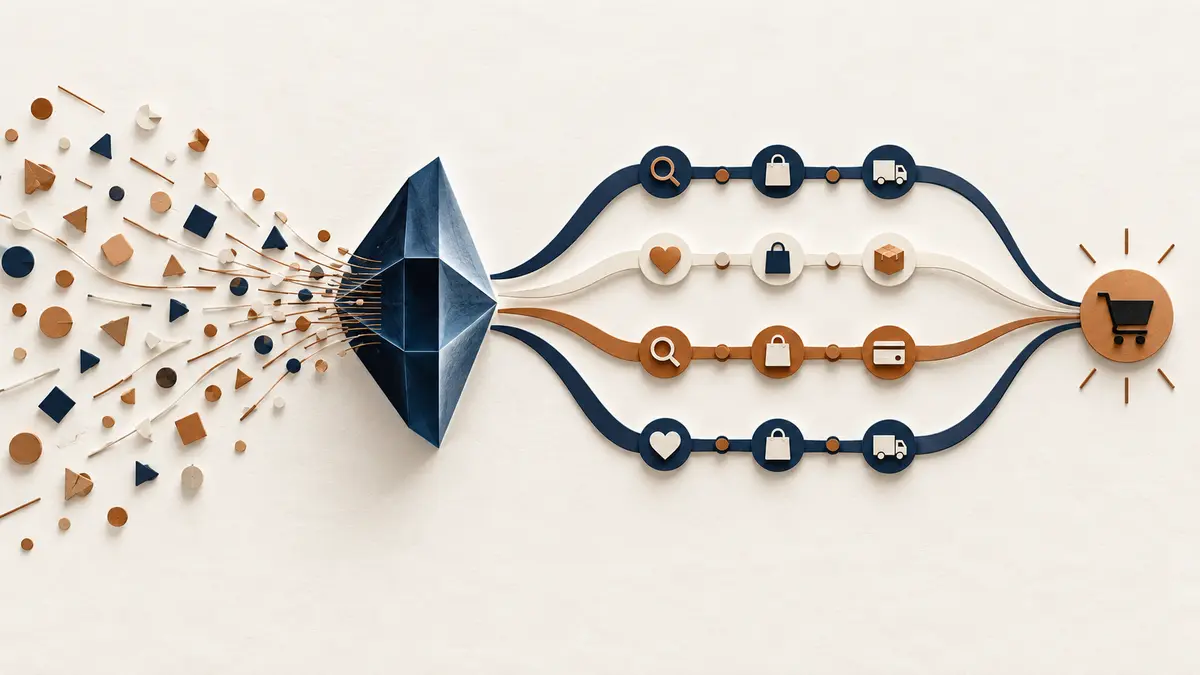
A persona is useful only when it changes a decision
The most detailed customer profile can still be commercially useless. Age, location, interests and a fictional first name may make a slide look complete, but they do not tell an ecommerce leader which customer problem to prioritise, what proof the buyer needs, where the journey breaks or which audience deserves the next pound or dollar.
My verdict is simple: do not count personas; count the decisions they improve. A useful profile separates customers by a behaviour, need, buying occasion or obstacle that requires a different commercial response. It connects that difference to a page, message, offer, product path or retention action. Then the business tests whether the intended customer and outcome changed.
This is narrower than a general guide to using AI to understand customers. That guide explains how to organise evidence responsibly. This article documents what I learned in one ecommerce engagement and how I would govern the work now. Current search results are dominated by persona templates and definitions; the missing owner-level question is whether the research can support an investment decision.
It also matters to distinguish a segment from a profile. Shopify describes customer segments as dynamic, rule-based lists that group similar customers. A buyer profile is the interpretation used to decide what those patterns mean. The segment can be operationally precise while the profile can still be wrong. Keep the rules, source evidence and decision hypothesis visible.
The apparel case—and what the evidence does not prove
In an anonymised engagement for a global athletic-apparel business, my recorded method included analysis of current customers, website visitors and social signals; segmentation across demographic, socioeconomic, psychographic and professional information; campaign testing; collaboration with sales and product stakeholders; customer-cycle mapping; and conversion-focused activation.
The approved portfolio slide records more than 50 buyer profiles and a developed customer-cycle journey. It also reports 137% online-revenue growth and a 30% conversion-rate increase. Those figures are reproduced from the original source. They are not independently audited here, and the slide does not isolate incrementality or prove that building profiles alone caused the outcomes.
That limitation is commercially useful. The work combined research, planning, campaigns and journey optimisation. Price, product, inventory, traffic mix, promotions, seasonality and wider client-team decisions may also have contributed. The honest lesson is not “personas drove 137% growth”. It is that customer evidence became part of an operating system that connected audience understanding to observable buying decisions.
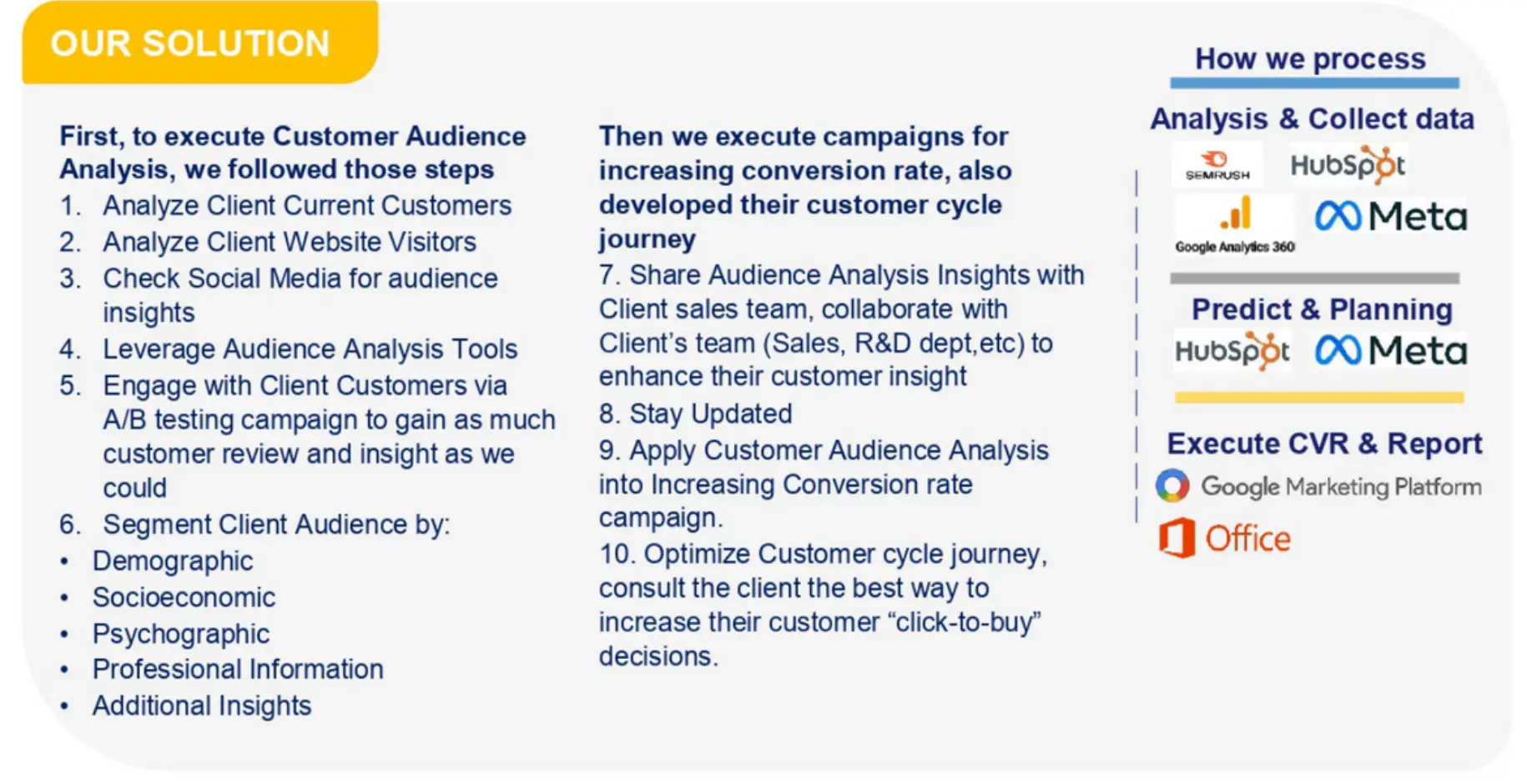
The source records customer and visitor analysis, audience segmentation, testing, cross-functional collaboration, conversion work and customer-cycle planning.
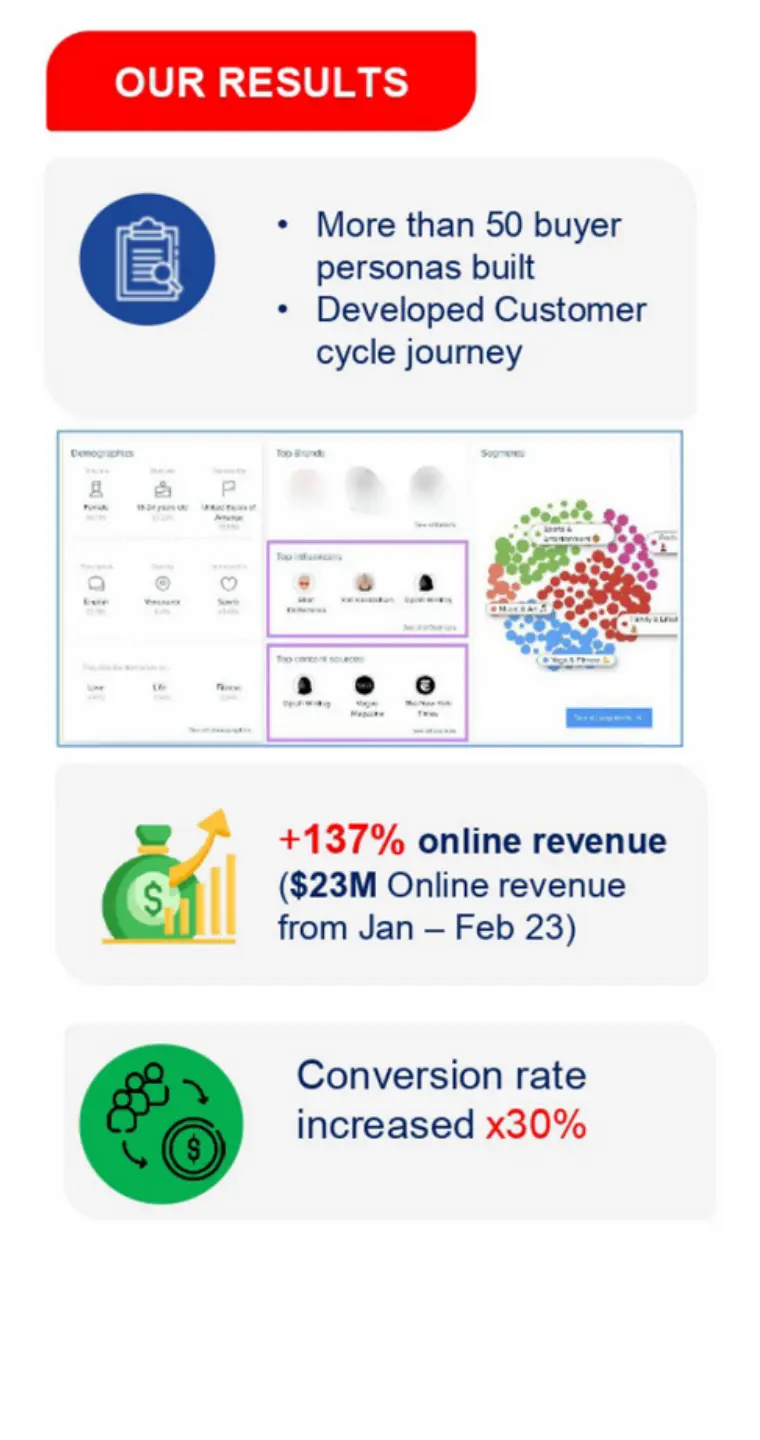
The source records 50+ buyer profiles, a developed customer journey, 137% online-revenue growth and a 30% conversion-rate increase. It does not establish a persona-only causal effect.
The Profile-to-Growth Decision Loop
I now judge customer-intelligence work through six stages. The loop starts with an owner decision, not a request to “build personas”. Each stage should preserve the evidence trail and narrow the next business move.
Name one business question
Choose a decision about market, message, product discovery, proof, conversion friction or retention.
Assemble permitted evidence
Use the smallest useful mix of transactions, behaviour, searches, reviews, support themes and direct research.
Find meaningful differences
Group customers by needs and behaviour that could justify a different action—not colourful biography details.
Locate the buying decision
Show where each profile discovers, evaluates, hesitates, buys, returns or leaves the journey.
Change one experience
Translate the hypothesis into a message, page, product path, proof block, offer or lifecycle intervention.
Read commercial evidence
Check whether the intended group experienced the change and whether the relevant business outcome moved.
Google Analytics separates new-user acquisition from session acquisition because the two scopes answer different questions. The same discipline belongs in customer research. Do not treat a session pattern as a stable person, or a correlation as a motive. Join quantitative behaviour to interviews, reviews or customer-service evidence before turning it into a confident profile.
AI can accelerate classification, summarisation and hypothesis generation. It cannot create permission, repair biased inputs or verify its own interpretation. Australian Government guidance recommends starting with a defined problem, assigning accountability, protecting personal data and checking AI output. For UK businesses, the ICO notes that profiling includes analysing or predicting a person's behaviour or preferences and can create new personal information. Privacy and governance therefore belong at the start of the loop.
Choose the next move from the evidence
| What leadership sees | Likely problem | Next decision | Avoid |
|---|---|---|---|
| Many profiles; no changed experience | Research without activation | Assign one profile to one journey decision and owner | Commissioning another persona deck |
| Profiles rely on demographics alone | Weak decision relevance | Add needs, buying occasions, objections and observed behaviour | Assuming similar people buy for the same reason |
| AI finds attractive themes that teams cannot trace | Unsupported inference | Return every theme to source evidence and human validation | Presenting model output as customer truth |
| One segment converts but returns products often | Acquisition and value misalignment | Review promise, product fit, margin and return reasons together | Scaling from conversion rate alone |
| Journey change helps one group and hurts another | Over-broad experience design | Create a controlled path or prioritise the higher-value need | Reporting only the blended average |
| A defined change improves verified value | Validated decision | Expand carefully and monitor the segment definition | Claiming the result will generalise forever |
The matrix prevents a common mistake: optimising for easy purchase while missing economic quality. If ecommerce revenue rises but contribution falls, use the Profit-to-Scale Bridge before declaring the profile successful. When leadership must choose the first group to fund, use the Customer Segment Decision Grid.
Claims need the same discipline as activation. The US Federal Trade Commission states that objective advertising claims need a reasonable basis before they are disseminated. Translate customer research into accurate, supportable benefits and proof—not invented certainty about what every member of a segment believes.
A 90-day customer-intelligence test
Choose the decision
Name one commercial problem, intended customer group, accountable owner, evidence boundary and success measure.
Build the evidence view
Combine permitted behavioural and qualitative sources. Record definitions, missing data, contradictions and AI-assisted steps.
Change one journey point
Test one message, discovery path, proof block or friction repair without changing every commercial variable at once.
Validate value
Compare the intended group, journey behaviour, purchase outcome and economics. Scale, revise or reject the profile.
Ninety days is a review structure, not a promised result window. High-frequency stores may gather evidence sooner; seasonal, premium or low-volume businesses may need longer. Pre-agree the minimum sample, decision threshold and external factors the review must consider.
For implementation, connect practical AI growth support, Meta Ads and broader growth partnership services to the same customer question. Review the original apparel case evidence, the evidence standards and Thomas's direct operating model before deciding whether the work fits.
Practitioner note: the 50+ profiles in this case were not the endpoint. The useful work was connecting analysis to planning, collaboration, campaign activation and the customer cycle. If a profile cannot change a real decision, consolidate or remove it.
Sources and evidence notes
Sources and current search results were checked on 10 September 2026. Search priority is qualitative; no unverified search volume, universal conversion benchmark or persona-performance forecast is claimed. Case metrics are reproduced from an approved anonymised portfolio slide with the limitations stated above. The Profile-to-Growth Decision Loop, decision matrix and 90-day test are original ThomPerformance practitioner analysis.
- ThomPerformance: anonymised global athletic-apparel audience-intelligence case
- Shopify Help Center: Customer segmentation
- Google Analytics: User acquisition versus traffic acquisition
- Australian Government: Using AI responsibly in business
- UK Information Commissioner's Office: Automated decision-making and profiling
- US Federal Trade Commission: Advertising substantiation policy
Frequently asked questions
What is a buyer profile in ecommerce?
A buyer profile is an evidence-based description of a group of customers who share a meaningful problem, buying context or behaviour. It should help the business make a specific decision about positioning, product discovery, proof, offers or the buying journey. It is not a fictional biography created from demographic assumptions.
How many buyer profiles does an ecommerce business need?
There is no universal number. Use the fewest profiles needed to explain commercially meaningful differences. A large catalogue, many markets or several buying occasions may justify more profiles, but leadership should still group them into a manageable set of decisions. Fifty profiles are useful only when the organisation can activate and validate them.
What data should ecommerce customer research use?
Useful inputs can include permitted transaction patterns, on-site behaviour, search terms, reviews, support themes, returns, surveys, interviews and campaign responses. Definitions, consent, access and retention must follow the business's privacy obligations. AI can organise patterns, but source evidence and accountable human review should remain visible.
Can buyer profiles improve ecommerce conversion rate?
They can improve the decisions that influence conversion, such as message relevance, product discovery, proof and friction reduction, but a profile does not cause a conversion by itself. Test one change against an agreed outcome and consider price, inventory, seasonality, promotions, traffic mix and site changes before claiming impact.
How should an ecommerce leader measure whether customer research worked?
Measure whether the research changed a decision, whether the intended customer experienced that change and whether relevant commercial evidence moved. Depending on the question, that may include qualified product engagement, checkout progression, purchase conversion, contribution margin, returns or repeat purchase. Record limitations rather than combining unlike metrics.
Turn customer knowledge into a governed growth decision
The apparel case taught me to judge buyer profiles by the journey decisions they improve, not the detail in the deck. Start with permitted evidence, separate meaningful differences, activate one change and validate commercial value without overstating causality. Customer intelligence earns investment when leadership can see that chain.
Which customer decision is currently expensive because the business is relying on assumption rather than evidence?