
A traffic plan is not a platform growth strategy
A platform can report more impressions, clicks and registrations while becoming no more valuable to users, partners or the business. I have seen the problem appear when teams treat paid media as the growth system instead of one entry point into it.
The commercial question is not “How do we buy more users?” It is “Which users create value, what must they do next, why will they return, and how does their participation improve the platform for someone else?”
My verdict is simple: do not scale acquisition until the journey after acquisition is visible. Define the first value event, cohort quality, retention window, partner contribution and monetisation path. Paid traffic becomes more useful when it supplies controlled evidence to that model.
The case that changed how I approached platform growth
In a Q3 2022 engagement for an anonymised global game and investor platform, my recorded scope extended beyond campaign delivery. It covered the campaign plan, landing-page and SEO review, competitor analysis, wider digital-entity work, paid and display activity, affiliate and creator programmes, and recurring performance reporting.
The portfolio record reports 200,000 new users, 3 million impressions and 35,000 clicks. It also records more than 200 user personas, a customer-cycle journey, a 137% increase in verified and top-performing affiliate/KOL programmes, and a 20% conversion-rate increase.
Those figures are reproduced from the original case slide; they are not an independent audit or a promise for another platform. The useful lesson is the pattern behind the work: the outcome was managed across audience understanding, discovery, conversion and partner participation—not attributed to one campaign setting.
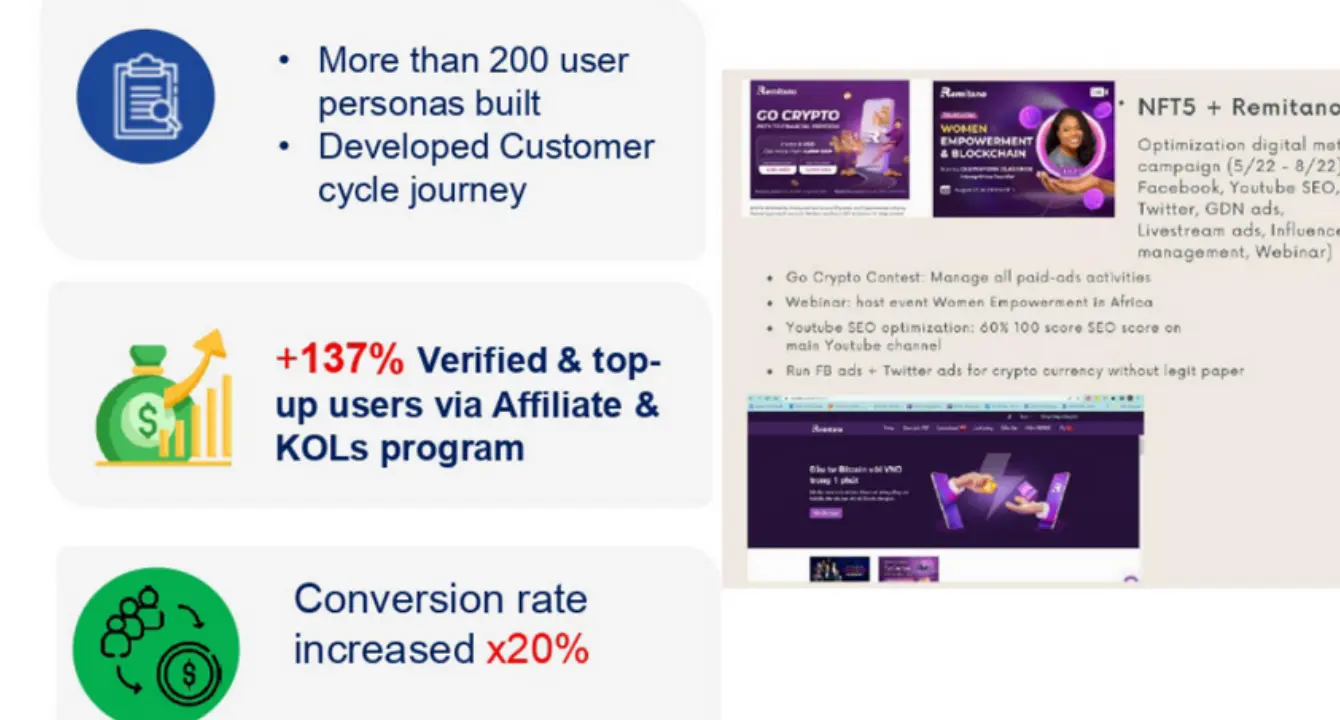
The source records 200+ user personas, a developed customer-cycle journey, 137% growth in verified and top-performing affiliate/KOL programmes and a 20% conversion-rate increase.
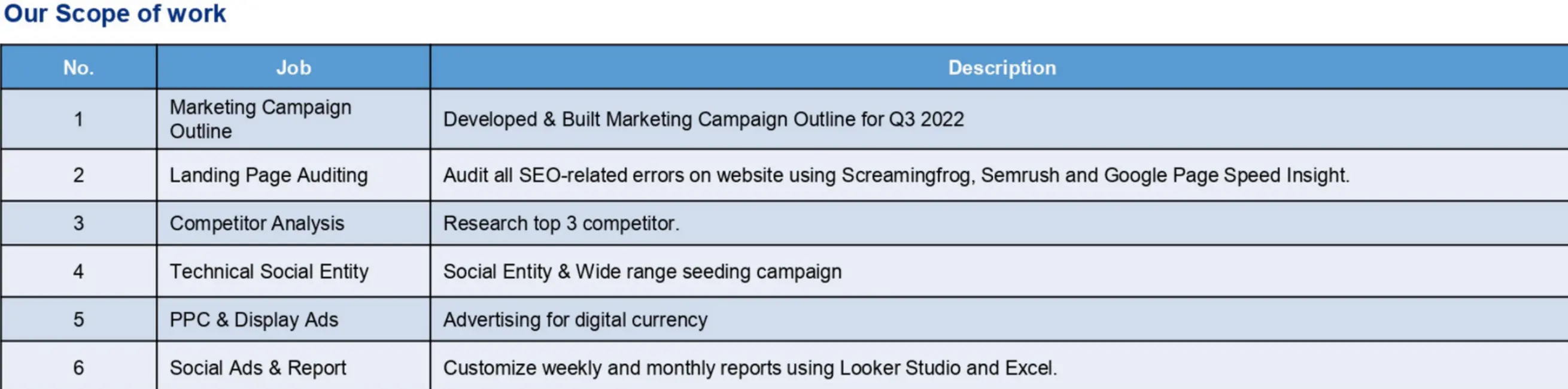
The scope table is valuable because it separates the work performed from the wider product, client-team and market factors that also affected results.
The Platform Growth Value Loop
I now use five connected stages when a founder asks whether marketing can grow a digital platform. Each stage needs an owner, a definition and evidence. If one is weak, more traffic usually magnifies the weakness.
Attract the right participant
Choose users by the problem, market and role they bring to the ecosystem—not the lowest visit or install cost.
Reach first value
Define the behaviour that shows a user has understood and received the platform's core benefit.
Create a reason to return
Measure cohorts over an honest window and diagnose whether product, content or community sustains use.
Improve the ecosystem
Evaluate affiliates, creators and partners by suitable users, useful supply or trusted participation—not reach alone.
Convert activity into value
Connect the core event and retained cohort to revenue, margin or another defensible commercial outcome.
The loop also works backwards. Monetisation tells you which retained behaviours matter. Retention clarifies which activation event deserves attention. Activation sharpens acquisition. Stronger cohorts make the platform more useful to the right partners.
Invest in the first constrained stage
| Observed pattern | Likely constraint | Owner decision | Avoid |
|---|---|---|---|
| Traffic grows; suitable activation does not | Audience, promise, onboarding or value clarity | Narrow acquisition and repair the first-value journey | Buying more low-intent registrations |
| Activation improves; cohorts disappear | Weak repeat value, product habit or lifecycle | Strengthen the return reason before scaling | Reporting total users as durable growth |
| Core users retain; partner output is weak | Partner fit, incentive or enablement | Recruit fewer suitable partners and measure downstream value | Rewarding reach without quality |
| Usage is healthy; revenue remains unclear | Monetisation model or commercial measurement | Test one value exchange with cohort economics visible | Assuming engagement will become revenue later |
| Suitable cohorts activate, retain and monetise | Acquisition capacity | Increase spend in controlled steps and compare cohorts | Scaling every channel at once |
This changes the budget conversation. A founder can fund the bottleneck instead of asking marketing to compensate for it. The same principle applies when choosing a first customer group: use the Segment Growth-Fit Matrix before fragmenting acquisition across many audiences.
Measure the journey without confusing scopes
Google Analytics structures its life-cycle reporting from acquisition through engagement, monetisation and retention. It also distinguishes user acquisition, which is scoped to new users, from traffic acquisition, which is scoped to sessions. Mixing those scopes can create confident but incorrect channel comparisons.
For apps, Apple similarly separates acquisition sources from retention cohorts. Its campaign-link reporting can connect downloads, usage, sales and subscriptions to a campaign, while its retention view shows whether people reopen the app after installation. The principle is useful even when the platform is web-based: acquisition quality is revealed by later behaviour.
I recommend one owner scorecard with five numbers: suitable new users, activation rate, retained cohort rate, partner-sourced value events and monetised value. Definitions and review windows must sit beside the numbers. Do not combine unlike platforms or time periods simply to create one attractive growth total.
Then connect the operating model to the wider business. Review the growth services, inspect the original platform case evidence, read the evidence policy and verify my direct operator background. If the immediate issue is channel investment, use the Next-Dollar Scale Test before increasing spend.
Sources and evidence notes
Sources and current search results were checked on 23 August 2026. Search priority is qualitative; no search volume, universal platform benchmark or forecast is claimed. Case metrics are reproduced from the approved ThomPerformance portfolio with limitations. The Platform Growth Value Loop, owner scorecard and decision matrix are original practitioner analysis.
Frequently asked questions
What is a digital platform growth strategy?
It is a coordinated plan for attracting the right users, helping them reach a valuable action, retaining appropriate cohorts, enabling partners and converting activity into sustainable commercial value. A media plan can support that strategy, but it does not replace product, journey, partner and measurement decisions.
Should a digital platform use paid advertising to grow users?
Paid advertising is useful when the platform has a defined user, valuable activation event, trustworthy measurement and a reason to expect acquired users to remain or monetise. Use it to test and scale specific demand, not to compensate indefinitely for weak onboarding, unclear value or low retention.
Which metric matters most for platform growth?
There is no universal single metric. Choose one core value event that reflects meaningful use, then connect it to acquisition source, activation, retention and revenue. Install, registration or traffic volume alone can look healthy while the platform fails to create repeat behaviour or commercial value.
How do partnerships support digital platform growth?
Affiliates, creators, communities and strategic partners can add trusted distribution, education and repeated participation. They work best when the platform defines suitable partners, tracks the users and value they produce, and rewards outcomes that support the ecosystem rather than raw reach.
How should a founder decide where to invest next?
Find the first constrained stage. Add acquisition budget only when suitable cohorts activate and retain. Repair onboarding when traffic arrives but value actions stall. Strengthen the product or lifecycle when activated users disappear. Expand partners when their users show better quality or create useful network participation.
Grow the value loop, not the traffic line
The platform case reinforced a principle I still use: acquisition is useful only when it connects to first value, retained use, partner contribution and commercial return. Diagnose the first weak link, give it an owner and scale only when suitable cohorts move through the system.
Which stage is limiting your platform today: acquisition, activation, retention, partners or monetisation?